

Table of Contents
Introduction
Google Search no longer works the way most marketers, publishers, and business owners think it does. The era of ranking a page with basic keyword optimization, backlink quantity, and occasional blog publishing is fading. In 2026, Google’s search ecosystem functions as a sophisticated intelligence system that evaluates intent, context, authority, usability, trust, experience, and predictive relevance simultaneously.
For website owners, understanding how the Google search algorithm works is no longer optional. It determines whether a business earns visibility or disappears beneath competitors in search results. It affects lead generation, organic traffic, authority building, online reputation, and revenue.
Many website owners still struggle with outdated SEO assumptions:
- “More keywords mean better rankings.”
- “Backlinks alone drive SEO success.”
- “Publishing AI content at scale guarantees traffic.”
- “Ranking on page one means long-term stability.”
These assumptions create confusion because Google Search in 2026 is powered by multiple interconnected systems rather than one simple ranking formula.
Search has become increasingly predictive and contextual. Google now evaluates search behavior patterns, page usefulness, user satisfaction, semantic relationships, expertise signals, topical authority, technical experience, and AI-assisted understanding to determine rankings.
At the same time, emerging experiences such as AI Overviews, Search Generative Experience (SGE), conversational search, multimodal search, and personalized contextual retrieval are reshaping how people discover information.
Businesses adapting to this evolution are seeing stronger visibility, better engagement, and more sustainable rankings. Those relying on outdated tactics often experience declining impressions, unstable traffic, and indexing challenges.
To understand where SEO is heading, businesses should first explore how AI is changing SEO in 2026.
This guide breaks down exactly how Google Search Algorithm works in 2026, what influences rankings, which systems matter most, common misconceptions, practical strategies, measurable KPIs, and how to adapt for long-term search visibility.
What Is Google Search Algorithm?
The Google Search Algorithm is a collection of systems, machine learning models, ranking signals, indexing technologies, and evaluation frameworks used to organize and rank billions of web pages.
Instead of relying on a single formula, Google uses hundreds of interconnected signals to decide:
- Which content should appear
- In what order it should rank
- Whether content deserves visibility
- Which result best satisfies intent
- What experience users are likely to prefer
In simple terms, Google tries to answer one question:
“What result best solves the searcher’s problem?”
In 2026, this decision depends on far more than keywords.
Google evaluates:
| Ranking Factor Category | Purpose |
|---|---|
| Relevance | Does content answer intent? |
| Authority | Is the source trustworthy? |
| Experience | Does the page feel useful and usable? |
| Context | Does the result match location, behavior, and search context? |
| Technical Quality | Is the website crawlable and accessible? |
| User Signals | Do users engage positively? |
| Semantic Understanding | Does content comprehensively cover a topic? |
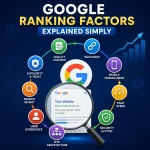
This evolution means SEO increasingly rewards quality, depth, expertise, and user satisfaction.
Businesses seeking sustainable visibility often combine modern search strategy with a structured SEO guide for beginners in 2026.
How Google Search Works in 2026: The 5-Step Process
To understand rankings, it helps to see how Google processes web information.
The workflow typically follows five stages:
- Crawling
- Indexing
- Understanding
- Ranking
- Re-ranking based on feedback signals
1. Crawling: Google Discovers Pages
Google starts by discovering pages through automated bots known as crawlers.
These systems scan websites and identify:
- New URLs
- Updated pages
- Internal links
- External references
- Structured data
- Media content
Crawling determines whether Google can access your content.
Poor crawlability causes major SEO problems.
Examples include:
- Broken internal links
- Crawl budget waste
- Duplicate URLs
- Server instability
- Slow-loading architecture
- Blocked resources
If Google cannot crawl a page efficiently, rankings become impossible regardless of content quality.
Website owners facing indexing challenges should understand how to index a website on Google faster and how to fix crawled currently not indexed pages.
2. Indexing: Google Stores Information
Once crawled, Google decides whether content deserves inclusion inside its index.
Think of indexing as Google’s searchable database.
Google evaluates:
- Originality
- Quality
- Trustworthiness
- Technical accessibility
- Duplication
- Content depth
- User value
Not every page gets indexed.
Common reasons for non-indexation include:
- Thin content
- Near-duplicate pages
- Low trust signals
- Weak topical relevance
- Technical conflicts
- Poor content quality
Submitting a sitemap helps discovery and indexing efficiency. Website owners should understand how to submit a sitemap to Google.
3. Semantic Understanding: Google Understands Meaning
This is where Google changed dramatically.
Instead of matching keywords literally, Google interprets:
- Search intent
- Topic relationships
- Context
- User expectations
- Natural language
For example, searching:
“best laptop for remote work”
does not simply return pages repeating the phrase.
Google understands semantic relevance including:
- Productivity
- Video conferencing
- Battery performance
- Portability
- Budget comparisons
- Hardware requirements
- Remote work workflows
This shift explains why keyword stuffing fails.
Instead, semantic topical coverage matters.
Strong content naturally incorporates related concepts, entities, and contextual explanations.
Businesses building content authority should learn modern keyword research for SEO and how to use AI for keyword research.
4. Ranking: Google Scores Relevance
After understanding content, Google determines ranking positions.
This stage includes multiple systems evaluating:
Relevance Signals
Google asks:
- Does content solve the query?
- Is it comprehensive?
- Does it satisfy user expectations?
Authority Signals
Google measures trust indicators such as:
- Brand credibility
- Mentions
- Link reputation
- Topical expertise
- Source trustworthiness
A focused niche website often outranks a larger site when authority alignment is stronger.
For deeper understanding, businesses should review Google ranking factors explained.
User Experience Signals
Google increasingly prioritizes usable experiences.
Factors include:
- Readability
- Navigation
- Mobile optimization
- Site speed
- Stability
- Engagement
Websites struggling with performance should review website performance and technical SEO best practices and ways to improve page speed using Google tools.
5. Re-Ranking: Behavioral Learning
Search rankings are dynamic.
Google observes:
- Click behavior
- Satisfaction signals
- Query reformulation
- Content freshness
- Engagement quality
- Relevance shifts
If users consistently abandon a page or refine their search afterward, rankings may weaken.
Conversely, pages satisfying intent may gain stronger visibility.
The Biggest Ranking Systems Behind Google Search in 2026
Google no longer relies on one algorithm update.
Instead, several systems work together.
Helpful Content System
This system prioritizes content built for humans rather than search manipulation.
Helpful content tends to:
- Solve problems clearly
- Demonstrate expertise
- Offer actionable value
- Show real experience
- Cover topics deeply
Low-value content often includes:
- Thin rewrites
- Generic summaries
- Search-engine-first writing
- Scaled low-quality AI output
- Surface-level information
Understanding the difference between automation and quality matters when evaluating AI content vs human content for SEO and whether AI-generated content ranks on Google.
RankBrain and Machine Learning Systems
Machine learning helps Google interpret:
- Ambiguous intent
- Search context
- Meaning relationships
- Engagement outcomes
Instead of static rules, ranking adapts continuously.
Google improves result prediction using behavioral patterns and semantic understanding.
Neural Matching
Neural matching connects ideas and meaning.
For example:
A page about “budget-friendly productivity laptops” may rank for “best affordable remote work computer” despite wording differences.
Why?
Google understands semantic equivalence.
Spam Detection Systems
Spam systems actively reduce visibility for:
- Link schemes
- Manipulative automation
- Deceptive redirects
- Scaled low-quality content
- Cloaking
- Hidden text
Sites depending on shortcuts frequently lose rankings after algorithm refreshes.
A safer approach includes avoiding common SEO mistakes.
Understanding Search Intent in 2026
Search intent is one of the strongest ranking influences in modern Google Search.
Google increasingly rewards pages that match what users actually want rather than what publishers assume they want.
In practical terms, a page ranks because it solves a problem better than alternatives.
Search intent generally falls into four categories:
| Intent Type | User Goal | Example Search |
|---|---|---|
| Informational | Learn something | “how Google ranking works” |
| Navigational | Find a destination | “Google Search Console login” |
| Commercial | Compare options | “best SEO tools for beginners” |
| Transactional | Take action | “hire SEO agency” |
Consider this example:
A user searches:
“best SEO software for small business”
Google expects:
- Feature comparisons
- Pricing insights
- Pros and cons
- Ease of use
- Beginner recommendations
- Real-world use cases
If a page only explains “what SEO software is,” it will likely underperform because it mismatches intent.
Businesses exploring beginner SEO platforms can compare options through this guide on best SEO tools for beginners.
Why Intent Matching Beats Keyword Density
Old SEO relied heavily on repeating phrases.
Modern search evaluates meaning.
For example, an article about “Google ranking factors” naturally covers:
- Content quality
- Technical SEO
- User experience
- Internal linking
- backlinks
- authority
- indexing
- search relevance
Without repeating one phrase excessively.
Google understands topic clusters, semantic relationships, and context.
That means:
Topic depth > keyword repetition
The Role of E-E-A-T in Google Rankings
In 2026, Google continues prioritizing signals often summarized as:
Experience, Expertise, Authoritativeness, Trustworthiness (E-E-A-T)
This framework helps Google assess content quality.
Experience
Google values evidence of first-hand knowledge.
Examples include:
- Real examples
- Case studies
- Practical recommendations
- Demonstrated usage
- Original observations
Content that feels genuinely informed tends to outperform generic rewrites.
Expertise
Google assesses subject understanding.
Signs include:
- Accurate terminology
- Detailed explanations
- Comprehensive coverage
- Practical knowledge
- Industry depth
Authoritativeness
Authority comes from reputation.
Examples include:
- Mentions
- citations
- backlinks
- brand recognition
- niche leadership
Businesses building authority often strengthen visibility through an effective off-page SEO and link-building strategy.
Trustworthiness
Trust remains foundational.
Google evaluates indicators such as:
- Transparent information
- Secure websites
- Accurate content
- Clear structure
- Reliability signals
Without trust, rankings struggle to stabilize.
How AI Changed Google Search in 2026
Artificial intelligence is now embedded across Google Search.
AI assists with:
- Query interpretation
- Result generation
- Search summaries
- predictive retrieval
- conversational experiences
- semantic understanding
Search increasingly behaves like an intelligent assistant.
This transition accelerated through Search Generative Experience.
Businesses adapting to modern search should understand how Google SGE and AI search works and broader trends shaping the future of SEO with artificial intelligence.
Google AI Overviews and Search Behavior
Users increasingly receive summarized answers directly inside search.
This changes click behavior dramatically.
Publishers must optimize for:
- Concise answers
- Structured formatting
- Semantic clarity
- Authority signals
- Topic completeness
Winning traffic increasingly requires becoming the cited source behind AI-generated responses.
Businesses competing in this environment should understand how to rank in AI search results.
Does Google Penalize AI Content?
No.
Google does not automatically penalize AI-generated content.
However, low-quality content fails regardless of production method.
Poor content usually includes:
- Repetition
- Weak originality
- shallow coverage
- inaccurate information
- poor intent alignment
- low expertise
High-performing content combines:
- Human expertise
- Editorial oversight
- fact checking
- semantic depth
- useful insights
This distinction matters when evaluating whether AI-generated content ranks on Google.
Important Ranking Signals in 2026
No single factor guarantees rankings.
Instead, Google evaluates clusters of signals.
Below are major categories.
1. Content Quality
Google prioritizes content that is:
- Useful
- Original
- Specific
- Actionable
- Accurate
- Comprehensive
Strong content usually:
- Answers intent quickly
- Expands depth logically
- includes examples
- anticipates questions
- covers adjacent subtopics
2. Topical Authority
Topical authority matters more than isolated articles.
Example:
A website publishing 100 high-quality SEO resources signals expertise better than one random article.
Strong topical clusters may include:
- keyword research
- indexing
- technical SEO
- analytics
- AI search optimization
- local SEO
- content optimization
Businesses improving organic visibility should also explore on-page SEO best practices for rankings.
3. Technical SEO
Technical quality still matters.
Google evaluates:
- crawlability
- rendering
- mobile usability
- page speed
- structured data
- Core Web Vitals
- indexing accessibility
Technical issues silently damage visibility.
Website owners should regularly audit technical performance through this guide to technical SEO and Core Web Vitals.
4. Backlinks and Authority
Backlinks still matter.
But quality beats quantity.
Google increasingly values:
- contextual relevance
- editorial mentions
- trusted sources
- topic alignment
Weak backlinks provide diminishing returns.
High-value authority signals come from relevant ecosystems.
5. User Experience Signals
Google prioritizes websites that feel usable.
Important factors include:
- readability
- mobile responsiveness
- navigation simplicity
- fast loading
- visual stability
A frustrating website often struggles despite strong content.
How Personalization Shapes Search Results
Google increasingly personalizes search.
Results may vary based on:
- location
- device
- language
- search history
- context
- behavior patterns
For example:
A local business search in Karachi differs significantly from the same query elsewhere.
This shift makes local optimization increasingly valuable.
Businesses seeking regional growth should invest in a strong local SEO strategy and modern approaches to digital marketing in Karachi.
Comparison Table: Old SEO vs Google Search in 2026
| Old SEO Approach | Modern SEO in 2026 |
|---|---|
| Keyword repetition | Intent satisfaction |
| Link quantity | Authority relevance |
| Thin articles | Topical depth |
| Generic blogs | Expert-driven resources |
| Desktop-first | Mobile-first experience |
| Static search behavior | AI-assisted search |
| Single keyword targeting | Semantic topic coverage |
| Manual optimization only | Human + AI workflows |
Common Mistakes
Even experienced publishers misunderstand how Google Search works.
Below are frequent ranking mistakes.
1. Publishing Content Without Intent Alignment
Many pages fail because they answer the wrong question.
Always ask:
What problem is the user trying to solve?
2. Ignoring Technical SEO
Great content fails if Google cannot crawl or index it efficiently.
Regular technical audits matter.
3. Overusing Exact Keywords
Keyword stuffing damages readability and user experience.
Modern SEO favors natural language.
4. Producing Low-Quality AI Content at Scale
Automation without editorial quality weakens trust.
Quality control matters more than publishing speed.
5. Weak Internal Linking
Internal links help Google understand topic relationships.
Businesses scaling content strategy should understand how to grow a business online through SEO and content.
6. Ignoring Search Analytics
Data reveals performance opportunities.
Website owners should learn how to use Google Search Console for SEO and implement a proper Google Analytics setup guide.
Advanced Strategies
Businesses competing in search in 2026 need more than basic optimization. Sustainable rankings increasingly come from strategic systems, editorial quality, technical consistency, and audience understanding.
Below are advanced approaches used by high-performing publishers and search-driven businesses.
Build Topic Clusters Instead of Random Articles
One of the biggest ranking advantages in 2026 comes from topical authority.
Google increasingly rewards websites demonstrating deep expertise across a subject.
Instead of publishing disconnected articles, organize content into related clusters.
For example, an SEO-focused website might create content around:
- Keyword research
- Technical SEO
- Content optimization
- Link building
- Analytics
- AI search
- Local SEO
- Search intent
- Google indexing
- Site performance
This structure helps Google understand expertise breadth and contextual relationships.
A strong content ecosystem naturally improves semantic relevance.
Businesses building search visibility should strengthen content depth with resources like keyword research strategies for SEO growth, on-page SEO optimization frameworks, and off-page SEO link-building strategies.
Optimize for AI Overviews and Featured Snippets
Search visibility in 2026 extends beyond blue links.
Google increasingly surfaces summarized answers inside AI-driven experiences.
To improve citation potential:
- Answer questions directly
- Use structured headings
- Write concise summaries
- Add comparison tables
- Use numbered lists
- Clarify definitions early
- Support claims with useful context
For example:
Instead of vague introductions, answer key questions immediately.
Poor approach
“SEO is important in today’s digital landscape…”
Better approach
“Google Search Algorithm in 2026 evaluates relevance, authority, user satisfaction, semantic understanding, technical accessibility, and contextual signals to rank web pages.”
Direct answers increase featured snippet eligibility.
Prioritize Information Gain
Google increasingly rewards original value.
Publishing what already exists rarely creates durable rankings.
Ask:
What can this article contribute that competitors missed?
Examples include:
- Original frameworks
- Real examples
- Contrarian insights
- Case studies
- proprietary data
- practical workflows
- expert recommendations
High-value content often includes perspectives unavailable elsewhere.
Use Human-Led AI Workflows
AI accelerates production but should not replace editorial thinking.
An effective workflow often looks like this:
| Stage | Human Role | AI Role |
|---|---|---|
| Research | Strategy and validation | Topic assistance |
| Outline | Editorial planning | Draft support |
| Writing | Expertise and nuance | Speed |
| Editing | Quality control | Grammar assistance |
| Optimization | Intent alignment | Semantic expansion |
Businesses evaluating automation should better understand AI content versus human content for SEO and practical AI-powered SEO workflows.
Improve Technical Experience Continuously
Technical optimization compounds over time.
Areas to monitor include:
- Core Web Vitals
- page rendering
- crawl efficiency
- mobile responsiveness
- indexing health
- structured data
Slow websites reduce satisfaction signals.
Businesses improving performance should regularly review technical SEO improvements and Core Web Vitals optimization and ways to improve page speed using Google tools.
Strengthen Internal Linking Architecture
Google relies heavily on contextual relationships.
Strategic internal links help search engines:
- Discover pages
- Understand hierarchy
- transfer authority
- improve crawlability
- reinforce topical clusters
A strong content ecosystem feels naturally connected rather than fragmented.
Key Metrics To Track
Understanding rankings requires measurement.
Many businesses obsess over rankings while ignoring more meaningful indicators.
Track these metrics consistently.
| Metric | Why It Matters |
|---|---|
| Organic Traffic | Measures visibility growth |
| Click-Through Rate (CTR) | Indicates SERP appeal |
| Impressions | Reveals keyword exposure |
| Average Position | Tracks ranking trends |
| Bounce Signals | Shows engagement quality |
| Pages Per Session | Indicates user interest |
| Conversion Rate | Measures business impact |
| Index Coverage | Identifies crawl problems |
| Core Web Vitals | Measures UX quality |
| Branded Search Growth | Signals authority |
Organic Traffic
Organic traffic remains a foundational KPI.
However, traffic quality matters more than raw numbers.
Ask:
- Are users converting?
- Are pages satisfying intent?
- Are visitors engaging?
Click-Through Rate (CTR)
A ranking without clicks creates little value.
Improve CTR through:
- stronger titles
- clearer relevance
- compelling meta descriptions
- better alignment with intent
Impressions
Growing impressions indicate increasing search visibility.
Sometimes impressions rise before clicks.
This often signals positive momentum.
Index Coverage
Many sites unknowingly lose visibility because pages are excluded.
Regularly monitor indexing health through Google Search Console SEO workflows.
Engagement Metrics
Metrics like:
- time on page
- scroll depth
- return visits
- interaction patterns
can reveal content quality.
If users leave immediately, intent mismatch may exist.
Analytics Tracking
Reliable measurement depends on proper setup.
Businesses should implement a structured Google Analytics configuration guide.
Real-World Scenario: Why Two Similar Pages Rank Differently
Consider two websites targeting:
“How Google Search Algorithm Works in 2026”
Website A
- Repeats keywords excessively
- shallow explanations
- generic writing
- poor formatting
- slow page speed
- weak expertise signals
Website B
- Covers user intent deeply
- explains ranking systems clearly
- includes examples
- uses semantic relevance
- answers FAQs
- demonstrates expertise
- loads quickly
- structures information logically
Google almost always favors Website B.
Why?
Because Website B creates stronger user satisfaction.
Search success increasingly depends on usefulness rather than manipulation.
Key Takeaways
Understanding Google Search Algorithm in 2026 requires abandoning outdated assumptions.
The modern search ecosystem rewards usefulness, expertise, semantic relevance, authority, and technical quality.
Key lessons include:
- Google uses interconnected systems rather than one formula.
- Search intent matters more than keyword repetition.
- Topical authority improves long-term rankings.
- Technical SEO still affects visibility significantly.
- AI content succeeds only when quality remains high.
- User experience increasingly influences performance.
- Internal linking strengthens semantic relationships.
- Search personalization changes result visibility.
- Helpful, structured content performs better in AI search.
- Sustainable SEO requires consistent optimization.
Businesses investing in future-ready strategies should understand how AI is reshaping search visibility, Google SGE and AI search evolution, and the growing debate around whether ChatGPT will replace Google Search.
Frequently Asked Questions
1. How does Google Search Algorithm work in 2026?
Google Search Algorithm works by crawling, indexing, understanding, ranking, and continuously re-evaluating web content using hundreds of signals including intent, authority, user experience, technical accessibility, and semantic relevance.
2. Does Google still use keywords in 2026?
Yes, but keywords matter differently. Google prioritizes meaning, context, and intent over exact keyword repetition.
3. Are backlinks still important?
Yes. High-quality, relevant backlinks remain valuable, but contextual authority matters more than link quantity.
4. Does Google penalize AI-generated content?
Google does not automatically penalize AI content. Low-quality, inaccurate, repetitive, or unhelpful content performs poorly regardless of whether humans or AI created it.
5. What matters most for SEO in 2026?
Intent satisfaction, topical authority, content usefulness, technical SEO, user experience, and trust signals remain essential.
6. What is Google AI Overview?
AI Overview is Google’s AI-assisted search experience that summarizes information directly inside search results to answer user questions faster.
7. How can I rank in Google Search in 2026?
Focus on useful content, semantic topic coverage, technical optimization, internal linking, authority building, and excellent user experience.
8. Is technical SEO still important?
Yes. Crawlability, indexing, speed, mobile usability, and Core Web Vitals directly affect search performance.
9. What tools help improve SEO performance?
Tools like Google Search Console, Google Analytics, keyword research platforms, and technical auditing tools help improve performance.
10. How often does Google update rankings?
Google continuously adjusts rankings through machine learning systems, algorithm refinements, and search quality improvements.
Conclusion
Google Search Algorithm in 2026 operates less like a static ranking engine and more like an intelligent decision-making system designed to surface the most useful answer for every search.
Success no longer comes from shortcuts.
Modern rankings increasingly depend on understanding users, solving problems clearly, building topical authority, improving technical performance, and maintaining trust.
Businesses and publishers that continue relying on outdated SEO tactics may struggle to compete as search becomes more contextual, semantic, and AI-driven.
The strongest strategy moving forward is simple: create genuinely helpful content, structure information clearly, optimize user experience, and build expertise over time.
Organizations preparing for the next generation of visibility should continue learning through resources on future-ready SEO strategies, modern ranking signals and optimization, and how to grow business visibility online through SEO.
The websites winning in 2026 are not chasing loopholes. They are building trust, authority, clarity, and usefulness at scale.


Best