
Table of Contents
Introduction
Artificial intelligence has transformed content creation faster than most marketers expected. Businesses now publish blog posts, product descriptions, landing pages, email campaigns, and even technical documentation using AI-powered writing tools. This shift has triggered one major question across the SEO industry: Does AI content actually rank on Google?
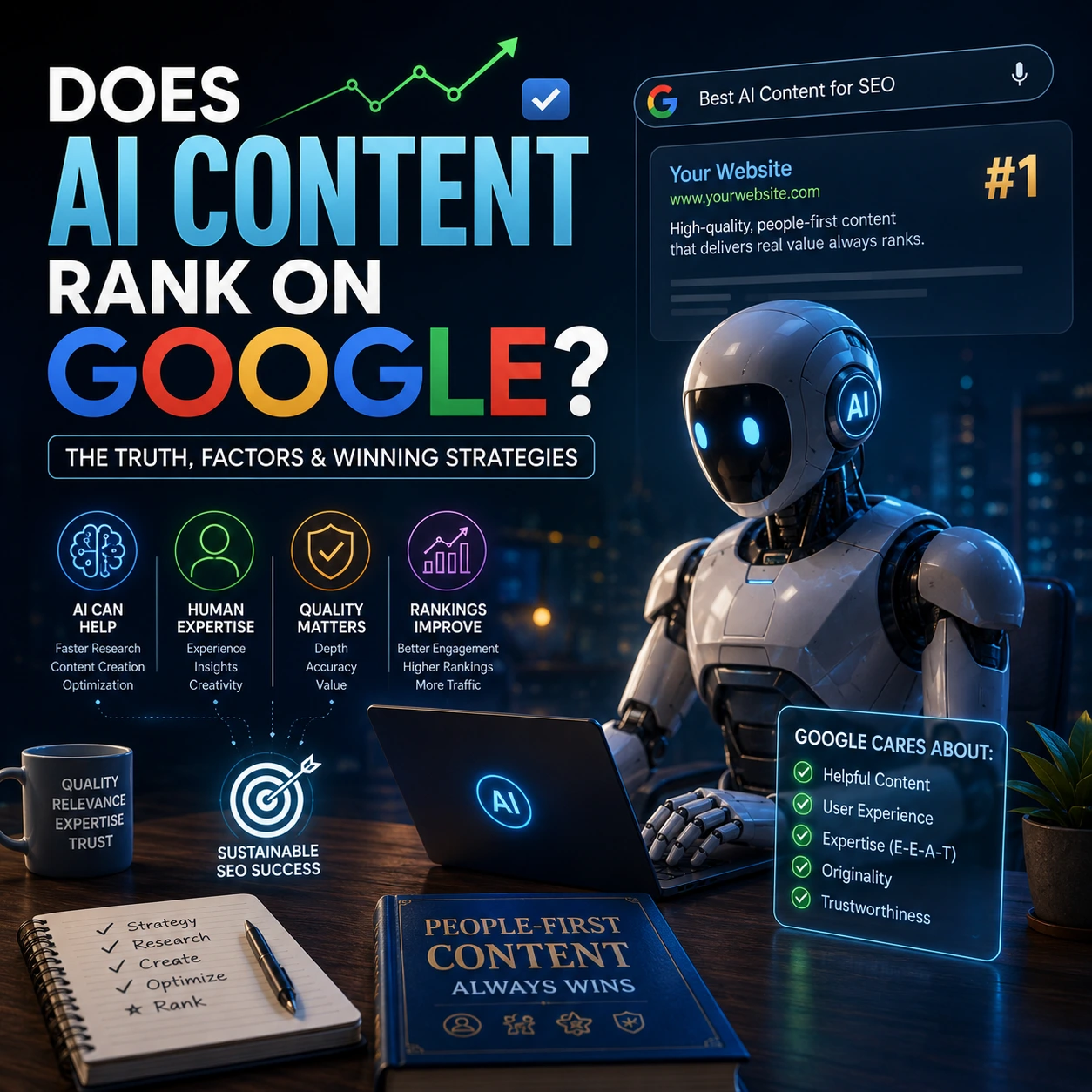
The short answer is yes. AI-generated content can rank extremely well on Google when it delivers value, satisfies user intent, demonstrates expertise, and maintains high editorial quality. However, not all AI content performs equally. Some pages dominate search results while others disappear into obscurity or get deindexed entirely.
The difference lies in how the content is created, edited, optimized, and aligned with Google’s evolving quality systems.
Google’s algorithms no longer focus solely on keywords and backlinks. Search engines now evaluate usefulness, topical authority, user experience, semantic depth, originality, trust signals, and behavioral engagement. This means low-quality AI content generated at scale without human oversight often fails, while expertly crafted AI-assisted content can outperform traditionally written pages.
The rise of AI-generated content has also changed the broader SEO landscape. Businesses now compete in a faster publishing environment where quality matters more than quantity. Understanding how AI content interacts with search algorithms has become essential for publishers, agencies, entrepreneurs, and content marketers who want sustainable rankings.
This guide explores exactly how Google evaluates AI content, when AI-generated articles rank successfully, the risks involved, how modern algorithms detect low-quality automation, and the best strategies for creating AI-assisted content that performs long term.
What Google Says About AI Content
Google has clarified its position on AI-generated content multiple times. Contrary to popular myths, Google does not automatically penalize content simply because artificial intelligence helped create it.
The real issue is quality.
Google’s official guidance emphasizes that content created primarily to manipulate search rankings violates spam policies, regardless of whether humans or AI produced it. Helpful, reliable, people-first content remains the priority.
This means AI content can rank if it:
- Solves user problems
- Provides accurate information
- Demonstrates expertise
- Offers originality
- Matches search intent
- Maintains readability
- Adds genuine value
Google’s Helpful Content System focuses heavily on usefulness rather than authorship method.
As discussed in the detailed analysis on how AI is changing SEO in 2026, modern search systems increasingly evaluate contextual quality signals instead of relying on simplistic content detection models.
Google’s E-E-A-T Standards Matter More Than Ever
AI-generated content must still align with Google’s E-E-A-T principles:
| E-E-A-T Factor | Meaning |
|---|---|
| Experience | Real-world familiarity with the topic |
| Expertise | Demonstrated subject knowledge |
| Authoritativeness | Industry trust and credibility |
| Trustworthiness | Accuracy, transparency, and reliability |
AI alone cannot automatically create genuine experience. This is why successful AI-assisted content usually involves human editing, expert insights, proprietary data, case studies, or firsthand examples.
Can Google Detect AI Content?
This question generates enormous debate.
Technically, Google can identify patterns commonly associated with AI-generated writing, but detection itself is not the main ranking factor.
Google’s systems are more focused on identifying:
- Thin content
- Repetitive phrasing
- Low originality
- Search manipulation
- Poor user satisfaction
- Scaled spam automation
- Lack of expertise
- Generic summaries
Many AI detectors used publicly are unreliable and frequently produce false positives. Even human-written articles often trigger AI detection tools incorrectly.
Instead of detecting AI directly, Google evaluates overall content quality and usefulness.
Signals That Often Hurt AI Content Rankings
Poorly generated AI articles commonly include:
- Predictable sentence structures
- Generic introductions
- Surface-level explanations
- Excessive keyword repetition
- Lack of original insights
- Fact inaccuracies
- Weak topical depth
- Recycled web summaries
- No clear author perspective
These weaknesses make content less valuable to users.
Google’s algorithms increasingly prioritize user engagement signals, semantic completeness, and informational satisfaction.
Why Some AI Content Ranks Extremely Well
Many top-ranking websites already use AI-assisted workflows.
AI tools help with:
- Research acceleration
- Topic clustering
- Draft generation
- Content outlining
- Metadata creation
- Semantic keyword discovery
- Content expansion
- Readability optimization
The key distinction is editorial oversight.
High-performing AI-assisted articles are rarely published untouched. They undergo strategic refinement by skilled editors and SEO professionals.
Factors That Help AI Content Rank
1. Strong Search Intent Matching
Successful pages answer exactly what users want.
For example:
| Search Query | Intent Type |
|---|---|
| “Does AI content rank?” | Informational |
| “Best AI writing tool for SEO” | Commercial |
| “How to optimize AI articles” | Educational |
| “AI content services” | Transactional |
Matching user intent is more important than whether AI helped create the article.
Understanding intent alignment is essential for modern SEO strategies, especially in the era of AI-driven search systems discussed in how Google SGE AI search works.
2. Human Editing Improves Rankings
Pure AI-generated text often lacks nuance, authority, and strategic depth.
Human editors strengthen content by adding:
- Real examples
- Expert commentary
- Brand voice
- Industry context
- Case studies
- Original analysis
- Data interpretation
- Personal experience
This creates content differentiation.
3. Topical Authority Matters
Google rewards websites that consistently cover related subjects comprehensively.
A single AI article rarely ranks long term without broader topical relevance.
For example, a website covering:
- Keyword research
- Technical SEO
- AI search
- Content optimization
- Local SEO
- Link building
builds stronger authority than a site publishing isolated AI-generated posts.
The topical authority model is explained further in the complete SEO guide for beginners 2026.
Common Mistakes With AI Content
Many publishers fail because they misuse automation.
Publishing Unedited AI Drafts
Raw AI outputs often contain:
- Generic wording
- Factual errors
- Weak transitions
- Repetitive structures
- Shallow explanations
Publishing without editing severely limits ranking potential.
Prioritizing Quantity Over Quality
Some websites generate hundreds of low-quality articles rapidly.
This strategy may create temporary traffic spikes but often collapses after algorithm updates.
Google increasingly targets scaled low-value content production.
Ignoring User Experience
AI content alone cannot compensate for:
- Slow website speed
- Poor design
- Weak navigation
- Intrusive ads
- Mobile usability issues
Technical optimization still matters significantly.
The technical SEO guide covering Core Web Vitals and website performance explains how site experience impacts rankings.
Keyword Stuffing
AI-generated content sometimes overuses target keywords unnaturally.
Modern SEO relies more on semantic relevance and contextual depth than exact-match repetition.
Lack of Originality
If AI merely rewrites existing information, the article adds little value.
Google prefers content that contributes:
- New insights
- Unique perspectives
- Fresh data
- Better explanations
- Actionable recommendations
How Google’s Helpful Content System Impacts AI Articles
Google’s Helpful Content System is designed to reward people-first content.
This system evaluates whether pages appear genuinely useful or created mainly for search engine manipulation.
Characteristics of Helpful AI-Assisted Content
Helpful content usually:
- Solves real problems
- Demonstrates expertise
- Covers topics deeply
- Maintains clarity
- Provides actionable value
- Answers follow-up questions
- Uses natural language
- Includes contextual relevance
Characteristics of Unhelpful AI Content
Unhelpful pages often:
- Exist only to target keywords
- Lack substance
- Rephrase competitor content
- Avoid specificity
- Provide no expertise
- Contain filler paragraphs
Google’s systems increasingly recognize these patterns.
AI Content vs Human Content for SEO
The debate between AI-generated and human-written content is more nuanced than many assume.
The most effective strategy today is hybrid creation.
Comparison Table
| Factor | AI Content | Human Content |
|—|—|
| Speed | Extremely fast | Slower |
| Scalability | High | Limited |
| Creativity | Moderate | High |
| Original insights | Weak alone | Strong |
| Consistency | High | Variable |
| Emotional nuance | Limited | Strong |
| Research efficiency | Excellent | Moderate |
| Cost efficiency | High | Lower |
The reality is that AI works best as an assistant, not a full replacement.
The deeper comparison available in AI content vs human content for SEO explains how hybrid workflows outperform purely automated publishing.
Advanced Strategies for Ranking AI Content
Advanced Strategies
Build Content Clusters
Instead of publishing isolated articles, create interconnected topic ecosystems.
Example cluster:
- AI SEO fundamentals
- AI content optimization
- AI search ranking factors
- AI content editing strategies
- Future of AI in search
Internal linking strengthens semantic authority.
For broader implementation strategies, businesses often use structured digital growth frameworks like those discussed in grow business online.
Use Proprietary Insights
Google increasingly values information unavailable elsewhere.
Include:
- Internal data
- Surveys
- Industry observations
- Client case studies
- Performance benchmarks
- Unique frameworks
This creates differentiation.
Optimize for AI Search Engines
Modern search is evolving rapidly.
AI-powered search systems increasingly summarize content directly within results pages.
To stay competitive:
- Answer questions clearly
- Use structured formatting
- Create concise definitions
- Include comparison tables
- Optimize for conversational queries
The future implications are explored in future of SEO with artificial intelligence.
Improve Semantic Depth
Top-ranking AI-assisted content usually covers related subtopics comprehensively.
Instead of focusing narrowly on one keyword, include semantically related entities naturally.
Example related terms:
- Search intent
- Topical authority
- NLP optimization
- E-E-A-T
- Semantic SEO
- Content quality signals
- Search algorithms
How AI Search Changes Ranking Dynamics
Search engines are shifting toward answer engines.
This evolution affects content strategy dramatically.
Traditional SEO focused heavily on:
- Keyword targeting
- Backlinks
- SERP positioning
Modern AI search systems increasingly prioritize:
- Direct answer quality
- Contextual relevance
- Conversational optimization
- Entity relationships
- User satisfaction signals
Businesses adapting early gain significant advantages.
The transition from traditional SEO toward AI-driven optimization is discussed extensively in AEO vs SEO: what marketers must know.
Case Study: Why Some AI Websites Lose Traffic
Many AI-generated content websites experienced major visibility declines after Google updates.
Common reasons include:
- Mass-produced thin content
- Lack of editorial review
- Weak expertise signals
- Minimal originality
- Excessive automation
- Poor UX
- Low trust indicators
Meanwhile, websites using AI strategically with strong human oversight often continued growing.
This highlights a critical reality:
AI is a tool, not a shortcut.
Key Metrics To Track
Tracking performance helps determine whether AI-assisted content succeeds.
Essential SEO Metrics
| Metric | Why It Matters |
|---|---|
| Organic traffic | Measures visibility |
| Click-through rate | Indicates SERP appeal |
| Bounce rate | Reflects engagement quality |
| Time on page | Measures user interest |
| Conversion rate | Evaluates business impact |
| Keyword rankings | Tracks SEO progress |
| Indexed pages | Reveals crawl efficiency |
| Backlinks earned | Signals authority |
User Behavior Signals
Google increasingly values behavioral engagement.
Important indicators include:
- Scroll depth
- Repeat visits
- Session duration
- Interaction rate
- Navigation patterns
Strong engagement often correlates with higher rankings.
Does AI Content Violate Google Policies?
Not inherently.
Google focuses on intent and quality rather than creation method.
AI content becomes problematic when used for:
- Spam generation
- Search manipulation
- Mass duplication
- Automated low-value publishing
Responsible AI-assisted publishing remains fully viable.
How To Create AI Content That Actually Ranks
Step 1: Start With Strong Keyword Research
Identify:
- User intent
- Search demand
- Competition level
- Semantic variations
- Long-tail opportunities
The keyword research SEO guide explains advanced research frameworks in detail.
Step 2: Create Detailed Outlines
Well-structured outlines improve:
- Topic coverage
- Logical flow
- Readability
- Semantic completeness
Step 3: Use AI for Draft Assistance
AI works effectively for:
- Draft generation
- Research summaries
- Subtopic expansion
- Formatting support
But avoid publishing raw outputs.
Step 4: Add Human Expertise
Enhance content with:
- Experience
- Real examples
- Industry knowledge
- Unique analysis
Step 5: Optimize On-Page SEO
Critical optimization elements include:
- Title tags
- Meta descriptions
- Internal linking
- Header structure
- Schema markup
- Image optimization
A detailed on-page SEO checklist for better rankings can help improve these areas systematically.
Step 6: Build Authority Signals
Strengthen trust using:
- Author bios
- Citations
- Expert quotes
- Transparent sourcing
- Secure website infrastructure
The Future of AI Content and Google Rankings
AI-generated content will continue expanding rapidly.
However, ranking competition will become more sophisticated.
Google’s systems are evolving toward evaluating:
- Informational originality
- Trustworthiness
- Real expertise
- User satisfaction
- Contextual usefulness
This means low-effort automation becomes increasingly risky.
At the same time, businesses using AI strategically can scale quality content faster than ever before.
Will AI Replace Human SEO Writers?
Not completely.
AI excels at speed and efficiency, but human expertise remains essential for:
- Strategic thinking
- Emotional resonance
- Original insights
- Storytelling
- Brand positioning
- Experience-based knowledge
The broader implications are discussed in will ChatGPT replace Google search.
Most successful SEO teams now combine:
- AI automation
- Human editing
- Strategic optimization
- Technical SEO
- User experience refinement
Common SEO Mistakes With AI Content
Many businesses unknowingly sabotage rankings.
Major Errors Include
- Publishing without fact-checking
- Ignoring topical depth
- Using identical templates repeatedly
- Weak internal linking
- Poor readability
- No content differentiation
- Over-automation
- Lack of expertise signals
Avoiding these pitfalls significantly improves long-term visibility.
The broader list of common SEO mistakes explains additional ranking issues publishers often overlook.
AI Content and Local SEO
AI-generated content can also support local visibility when properly optimized.
Businesses targeting regional traffic should include:
- Geographic relevance
- Local terminology
- Regional intent
- Service-area optimization
- Local search behavior patterns
The local SEO guide explains how AI-assisted strategies can improve local rankings effectively.
Best AI Tools for SEO Content Creation
Several tools support modern SEO workflows.
Popular categories include:
- AI writing assistants
- Keyword research platforms
- Content optimization tools
- Technical SEO analyzers
- SERP intelligence platforms
Beginners looking to build efficient workflows can explore the best SEO tools for beginners.
Key Takeaways
- AI content can absolutely rank on Google
- Google prioritizes quality, usefulness, and user satisfaction
- Human editing significantly improves AI-generated content
- Low-quality automation creates long-term SEO risks
- E-E-A-T principles remain critical
- Helpful content consistently outperforms generic AI text
- Hybrid AI-human workflows are currently the strongest strategy
- Topical authority matters more than isolated keyword targeting
- Search is evolving toward AI-powered answer systems
- Sustainable rankings require value-driven publishing
Frequently Asked Questions
Does Google penalize AI-generated content?
No. Google does not penalize content simply because AI created it. The focus is on quality, usefulness, and user satisfaction.
Can AI-written blog posts rank on the first page?
Yes. High-quality AI-assisted articles with strong editing, SEO optimization, and valuable insights can rank very well.
Is human editing necessary for AI content?
In most cases, yes. Human oversight improves originality, expertise, trustworthiness, and engagement.
How does Google detect low-quality AI content?
Google evaluates patterns associated with poor-quality content such as thin information, repetition, lack of originality, and weak user engagement.
Can AI content hurt SEO?
Low-quality automated content published at scale can negatively impact rankings and overall site authority.
What type of AI content performs best?
AI-assisted content enhanced with expert insights, real examples, semantic depth, and strong UX typically performs best.
Does AI content work for local SEO?
Yes. AI-generated local content can rank effectively when optimized for geographic relevance and user intent.
Are AI detectors reliable?
Not entirely. Many AI detection tools generate false positives and cannot accurately determine authorship consistently.
Will AI replace human content writers?
AI will likely augment human writers rather than fully replace them. Strategic thinking and real expertise remain essential.
Is AI content the future of SEO?
AI-assisted workflows are becoming central to SEO, but sustainable rankings still depend on high-quality, people-first content.
Conclusion
AI content absolutely can rank on Google, but success depends on how it is created, optimized, and refined.
The era of simply generating massive quantities of low-effort content is fading quickly. Google’s algorithms increasingly reward quality, expertise, trust, usefulness, and genuine informational value. Businesses relying entirely on automation without human oversight face growing risks as search systems become more sophisticated.
At the same time, AI-assisted publishing offers enormous advantages when combined with strong editorial processes, semantic SEO strategies, topical authority building, and user-focused optimization.
The most successful websites today are not choosing between AI and humans. They are combining both strategically.
AI accelerates workflows, improves scalability, and enhances research efficiency. Human expertise adds originality, authority, emotional intelligence, and strategic depth. Together, they create content capable of ranking competitively in both traditional search engines and emerging AI-powered search experiences.
As search continues evolving, publishers who focus on value-first content creation rather than shortcuts will maintain the strongest long-term visibility.