
Table of Contents
Introduction
Search engine optimization has evolved into a data-driven discipline where success depends not only on strategy but also on the quality of tools you use. In today’s competitive digital landscape, ranking on Google is no longer about guesswork. It is about precision, insights, and execution powered by advanced SEO tools that reveal what users search, how competitors perform, and what search engines actually reward.
Whether you are a beginner trying to understand keyword research or a professional managing large-scale enterprise websites, SEO tools form the backbone of your workflow. They simplify complex data, highlight opportunities, and help you make decisions that directly impact visibility, traffic, and conversions.
The challenge is not the lack of tools, but the overwhelming number of them. Some tools are built for keyword discovery, others for technical audits, backlink analysis, or content optimization. Choosing the right combination determines how efficiently you grow organic traffic.
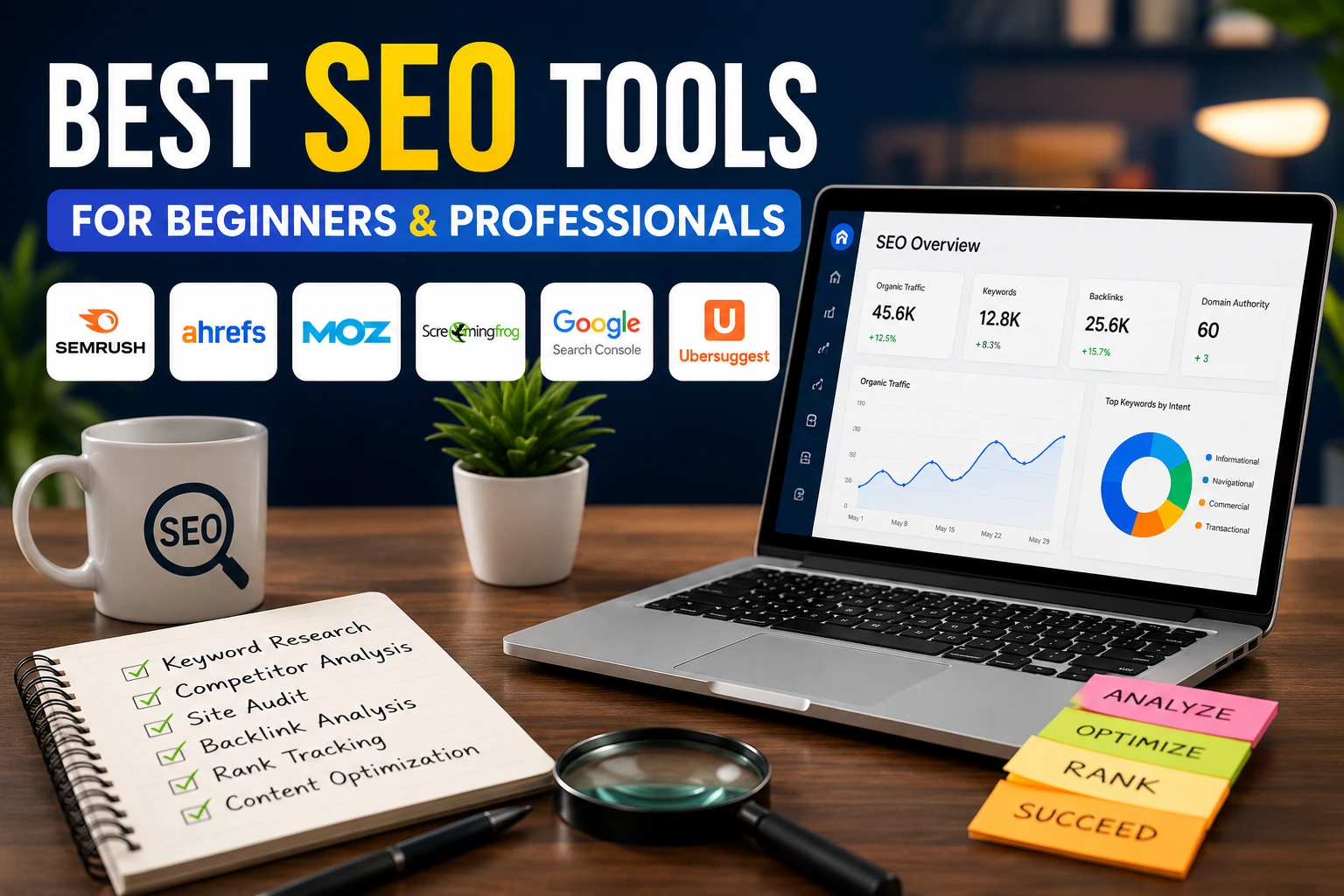
This guide breaks down the best SEO tools for beginners and professionals, how they work, when to use them, and how to build a complete SEO toolkit that aligns with modern search engine requirements. It also connects practical workflows with strategic insights so you can move from basic optimization to advanced SEO execution with confidence.
Why SEO Tools Matter in Modern Search Optimization
SEO tools are not just utilities; they are decision-making systems. They transform raw search data into actionable insights.
Here is what modern SEO tools help you achieve:
- Identify high-traffic, low-competition keywords
- Analyze competitor strategies in real time
- Audit technical issues affecting rankings
- Track backlinks and domain authority growth
- Optimize content for search intent alignment
- Monitor ranking fluctuations
- Improve site speed and Core Web Vitals
- Measure SEO ROI accurately
Without tools, SEO becomes guesswork. With tools, it becomes a measurable, scalable system.
For a foundational understanding of SEO principles, you can also explore this guide:
Complete SEO Guide
Categories of SEO Tools You Must Understand
Before choosing tools, it is important to understand their categories. Every professional SEO workflow is built around these core pillars:
1. Keyword Research Tools
Help identify what users are searching for and how often.
2. Technical SEO Tools
Help analyze website structure, performance, and crawlability.
3. On-Page SEO Tools
Help optimize content, metadata, and keyword placement.
4. Off-Page SEO Tools
Focus on backlinks, domain authority, and external signals.
5. All-in-One SEO Suites
Provide complete SEO ecosystems in a single platform.
6. Analytics and Tracking Tools
Measure traffic, rankings, and user behavior.
Each category plays a critical role in building a strong SEO foundation.
Best SEO Tools for Beginners
Beginners need tools that are simple, intuitive, and actionable. These tools should reduce complexity rather than increase it.
1. Google Search Console
Google Search Console is the most essential starting point for any SEO journey. It provides direct insights from Google itself.
Key features:
- Keyword performance tracking
- Index coverage reports
- Click-through rate (CTR) analysis
- Mobile usability insights
- Core indexing issues
Why beginners should use it:
It shows exactly how Google sees your website without interpretation layers.
2. Google Analytics
Google Analytics helps beginners understand user behavior.
You can track:
- Traffic sources
- User engagement
- Bounce rates
- Conversion paths
When combined with Search Console, it gives a full picture of SEO performance.
3. Ubersuggest
Ubersuggest is beginner-friendly for keyword research and content ideas.
Key features:
- Keyword suggestions
- Domain overview
- Content ideas generator
- Backlink data overview
It simplifies SEO into a visual dashboard that is easy to understand.
4. Yoast SEO (WordPress Users)
Yoast SEO helps beginners optimize on-page SEO directly inside WordPress.
It helps with:
- Meta title optimization
- Readability analysis
- Keyword density guidance
- XML sitemaps
Best SEO Tools for Professionals
Professional SEO requires deeper data, automation, and scalability.
1. Ahrefs
Ahrefs is one of the most powerful SEO tools in the industry.
Key capabilities:
- Advanced backlink analysis
- Keyword difficulty scoring
- Content gap analysis
- Competitor research
- Rank tracking
Why professionals use it:
It provides one of the largest backlink databases in the world.
2. SEMrush
SEMrush is an all-in-one SEO powerhouse.
Features include:
- Keyword magic tool
- Site audit system
- PPC research
- Competitor tracking
- Content optimization toolkit
SEMrush is ideal for agencies managing multiple clients.
3. Moz Pro
Moz Pro is known for its Domain Authority metric and clean interface.
It offers:
- Keyword explorer
- Site audits
- Link analysis
- Rank tracking
4. Screaming Frog SEO Spider
Screaming Frog SEO Spider is essential for technical SEO audits.
It helps professionals:
- Crawl websites
- Detect broken links
- Analyze redirects
- Audit metadata issues
- Identify duplicate content
Keyword Research Tools That Drive Traffic
Keyword research is the foundation of SEO success. Without it, content lacks direction.
Top Tools:
- Google Keyword Planner
- Ahrefs Keywords Explorer
- SEMrush Keyword Magic Tool
- Ubersuggest
Key insights you should extract:
- Search volume
- Keyword difficulty
- User intent (informational, transactional, navigational)
- Long-tail opportunities
For deeper strategy, read:
Keyword Research SEO Guide
Technical SEO Tools for Site Health
Technical SEO ensures your website is crawlable, indexable, and fast.
Essential Tools:
- Google Search Console
- Screaming Frog
- PageSpeed Insights
- GTmetrix
Key technical factors they analyze:
- Core Web Vitals
- Mobile responsiveness
- Crawl errors
- Site speed
- Indexation issues
For deeper optimization techniques:
Technical SEO Guide
On-Page SEO Tools for Content Optimization
On-page SEO focuses on optimizing individual pages for better rankings.
Key Tools:
- Yoast SEO
- Surfer SEO
- SEMrush Writing Assistant
They help optimize:
- Title tags
- Meta descriptions
- Content structure
- Keyword placement
- Internal linking
To improve your on-page strategy:
On-Page SEO Guide
Backlink Analysis and Off-Page SEO Tools
Backlinks remain one of the strongest ranking signals.
Top Tools:
- Ahrefs
- Moz Link Explorer
- SEMrush Backlink Analytics
What they help you track:
- Referring domains
- Anchor text distribution
- Toxic backlinks
- Competitor link strategies
For link-building strategy:
Off-Page SEO Guide
All-in-One SEO Platforms
These platforms combine multiple SEO functions into one system.
Leading Solutions:
- SEMrush
- Ahrefs
- Moz Pro
Benefits:
- Centralized workflow
- Better data consistency
- Time efficiency
- Advanced reporting
Free vs Paid SEO Tools
Free Tools
- Google Search Console
- Google Analytics
- Ubersuggest (limited)
- Keyword Planner
Advantages:
- Zero cost
- Beginner-friendly
- Reliable data from Google
Limitations:
- Limited features
- Lower data depth
- Restricted competitor analysis
Paid Tools
- Ahrefs
- SEMrush
- Moz Pro
Advantages:
- Advanced data insights
- Competitor intelligence
- Automation features
- Scalable for agencies
How to Choose the Right SEO Tools
Choosing SEO tools depends on your goals, budget, and experience level.
Beginners should focus on:
- Simplicity
- Free tools
- Learning curve
Professionals should prioritize:
- Data accuracy
- Scalability
- Automation
- Competitor analysis
Agencies should consider:
- Multi-project management
- Reporting features
- API access
- Collaboration tools
Common Mistakes When Using SEO Tools
Many users fail to get results because they misuse tools.
Mistakes include:
- Relying only on one tool
- Ignoring search intent
- Over-optimizing keywords
- Not analyzing competitors
- Misinterpreting data
- Ignoring technical SEO issues
Avoiding these mistakes significantly improves SEO performance.
Advanced Strategies Using SEO Tools
Once you understand basics, you can use tools strategically.
Advanced techniques:
1. Competitor Gap Analysis
Use Ahrefs or SEMrush to find keywords competitors rank for but you don’t.
2. Content Clustering
Group related keywords into topic clusters for authority building.
3. Automated Site Audits
Schedule weekly audits using Screaming Frog or SEMrush.
4. SERP Feature Targeting
Optimize for featured snippets, People Also Ask, and rich results.
5. Historical Data Tracking
Analyze ranking trends over time to identify algorithm impact.
Key Metrics to Track in SEO Tools
Tracking the right metrics is essential for growth.
Core SEO metrics:
- Organic traffic
- Keyword rankings
- Click-through rate (CTR)
- Bounce rate
- Domain authority
- Backlink growth
- Pages indexed
- Core Web Vitals
These metrics determine the true health of your SEO strategy.
Key Takeaways
- SEO tools are essential for modern ranking success
- Beginners should start with Google tools and simple platforms
- Professionals need advanced suites like Ahrefs and SEMrush
- Technical SEO tools ensure site health and crawlability
- Keyword research drives content strategy
- Backlinks remain a core ranking factor
- Using multiple tools provides better accuracy
- Strategy matters more than tools alone
Frequently Asked Questions
1. What is the best SEO tool for beginners?
Google Search Console is the best starting point because it provides direct insights from Google.
2. Are paid SEO tools worth it?
Yes, paid tools like Ahrefs and SEMrush provide deeper data and competitor insights.
3. Can I do SEO without tools?
Yes, but results will be slower and less accurate.
4. Which SEO tool is best for keyword research?
Ahrefs and SEMrush are the most advanced options.
5. What is the most important SEO metric?
Organic traffic and keyword rankings are the most critical metrics.
6. Do I need multiple SEO tools?
Yes, combining tools improves accuracy and coverage.
7. Is Google Analytics enough for SEO?
No, it only tracks traffic behavior, not keyword performance.
8. What is the difference between Ahrefs and SEMrush?
Ahrefs is stronger in backlinks, while SEMrush is better for all-in-one marketing.
9. How often should I use SEO tools?
Weekly monitoring is ideal for most websites.
10. Which SEO tools are best for technical audits?
Screaming Frog and Google Search Console are the most effective.
Conclusion
SEO success today is built on precision, not guesswork. The right tools give you the clarity needed to understand search behavior, optimize content, and outperform competitors. Whether you are just starting out or managing large-scale SEO campaigns, building a reliable toolkit is essential for long-term growth.
Begin with foundational tools like Google Search Console and Analytics, then gradually integrate advanced platforms such as Ahrefs and SEMrush as your strategy matures. Combine this with strong keyword research, technical optimization, and consistent monitoring, and you will have a complete SEO system capable of delivering sustainable organic growth.
For a complete foundation, revisit the core principles here:
Complete SEO Guide