
Table of Contents
Introduction
Search engines are entering a completely new era. For decades, traditional search relied on ranking web pages and presenting users with a list of links. Users searched, clicked websites, compared information, and manually found answers. That model shaped the internet economy, digital marketing, publishing, and online business growth for more than twenty years.
Now, artificial intelligence is fundamentally changing how search works.
Google Google’s Search Generative Experience, commonly known as Google SGE or AI Search, represents one of the biggest transformations in search engine history. Instead of simply showing blue links, Google now uses generative AI to create summarized answers, contextual insights, follow-up recommendations, and conversational search experiences directly inside search results.
This shift is reshaping:
- SEO strategies
- Organic traffic patterns
- User behavior
- Content marketing
- Website visibility
- Search monetization
- Online publishing
Businesses, marketers, publishers, and SEO professionals are rapidly trying to understand one crucial question: how does Google SGE actually work?
The answer matters because AI-powered search is already changing how users discover information online. Websites that fail to adapt may lose visibility, traffic, and authority as AI-generated search experiences continue expanding.
This article explores how Google SGE works, the technology behind AI search, how it impacts SEO, what changes for publishers and businesses, and how websites can optimize for the future of AI-driven search.
What Is Google SGE?
Google SGE stands for Search Generative Experience.
It is Google’s AI-powered search system that integrates generative artificial intelligence directly into search results.
Instead of only displaying traditional website listings, Google SGE can:
- Generate summarized answers
- Combine information from multiple sources
- Provide conversational responses
- Suggest follow-up questions
- Offer contextual recommendations
- Present AI-generated overviews
Google SGE aims to make search faster, more interactive, and more personalized.
Why Google Created SGE
Google developed AI-powered search because user expectations are changing rapidly.
Modern users increasingly want:
- Instant answers
- Summarized insights
- Conversational interactions
- Reduced search friction
- Personalized recommendations
The rise of AI chatbots accelerated this shift dramatically. The growing discussion around whether ChatGPT will replace Google Search pushed Google to integrate more advanced AI experiences into its search ecosystem.
SGE helps Google compete with AI-driven information tools while keeping users inside its own search environment.
How Traditional Google Search Works
Before understanding SGE, it helps to understand traditional search systems.
Traditional Google Search follows three major processes:
Crawling
Google bots scan billions of web pages across the internet.
Indexing
Google stores and organizes discovered content in its search index.
Ranking
Algorithms evaluate pages based on hundreds of ranking factors, including:
- Relevance
- Authority
- Backlinks
- Content quality
- User experience
- Technical SEO
- Search intent
Users then receive ranked search results.
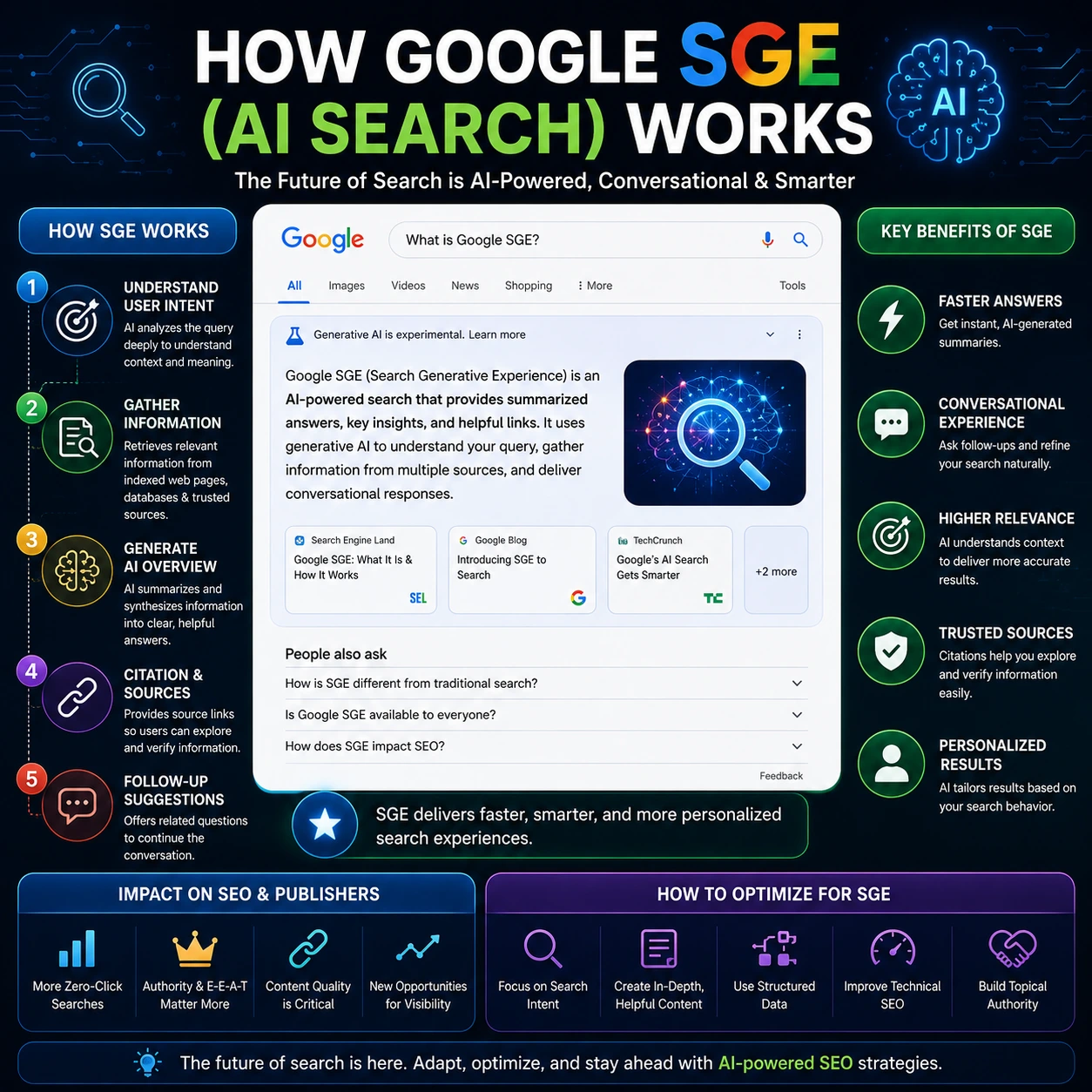
How Google SGE Works
Google SGE adds generative AI on top of traditional search infrastructure.
Step 1: Understanding User Intent
SGE first analyzes the user query deeply using advanced natural language processing.
Instead of focusing only on keywords, Google attempts to understand:
- Context
- Intent
- Meaning
- Relationships
- User goals
For example:
Traditional search query:
“Best laptops”
Conversational AI search query:
“What’s the best laptop for video editing under $1500?”
SGE interprets intent more contextually.
Step 2: Gathering Relevant Information
Google’s systems retrieve relevant information from:
- Indexed web pages
- Knowledge Graph entities
- Product databases
- Reviews
- Trusted sources
- Historical search patterns
Google still relies heavily on its traditional search index.
This is why strong SEO remains essential. A complete SEO Guide for Beginners remains highly relevant even in AI-powered search environments.
Step 3: AI Summarization
Generative AI models synthesize information into summarized responses.
Instead of presenting only links, SGE creates:
- Direct answers
- Key takeaways
- Summaries
- Recommendations
- Contextual insights
This process resembles conversational AI systems but is integrated directly into search results.
Step 4: Citation and Source Integration
Google typically includes supporting source links alongside AI-generated summaries.
This allows users to:
- Verify information
- Explore deeper details
- Visit original websites
Websites with strong authority signals may receive greater visibility in AI-generated overviews.
Step 5: Conversational Follow-Up Suggestions
SGE often suggests related follow-up questions.
For example:
- “What are the best gaming laptops?”
- “Which laptops have the longest battery life?”
- “What laptop is best for students?”
This creates a more interactive search journey.
Core Technologies Behind Google SGE
Google SGE combines multiple advanced technologies.
Large Language Models (LLMs)
LLMs power generative AI capabilities.
These models analyze language patterns across enormous datasets.
Natural Language Processing (NLP)
NLP helps Google understand conversational search queries and user intent.
Machine Learning Systems
Google continuously improves SGE using machine learning and behavioral feedback.
Knowledge Graph Integration
Google’s Knowledge Graph connects entities such as:
- People
- Companies
- Products
- Locations
- Concepts
This improves contextual understanding.
Real-Time Search Infrastructure
Unlike standalone AI systems, Google combines generative AI with live search indexing.
This improves freshness and relevance.
What Makes SGE Different From Traditional Search
Direct Answers Instead of Blue Links
Traditional search focuses on ranking websites.
SGE prioritizes AI-generated summaries.
Conversational Search Experience
Users can refine searches naturally through follow-up prompts.
Multi-Source Summarization
SGE combines insights from multiple sources into unified answers.
Reduced Search Friction
Users spend less time clicking between websites.
How Google SGE Impacts SEO
SGE is already changing SEO dramatically.
Zero-Click Searches Are Increasing
Users often receive answers directly inside search results.
This may reduce clicks for informational queries.
Authority Matters More
Google needs trustworthy sources for AI-generated answers.
Websites with strong:
- Expertise
- Authority
- Trust signals
- Brand recognition
may gain advantages.
Topical Authority Is Becoming Critical
Thin isolated articles are less effective.
Comprehensive topic coverage matters more.
Search Intent Optimization Is Essential
Content must directly solve user problems clearly and efficiently.
A detailed On-Page SEO Guide can help optimize content structure for AI-enhanced search systems.
How SGE Changes User Behavior
Users Expect Faster Answers
People increasingly prefer summarized information.
Conversational Queries Are Growing
Searches are becoming more natural and question-based.
Examples include:
- “How does Google AI search work?”
- “What is the best SEO strategy for AI search?”
Fewer Website Clicks
Users may consume information directly inside search results.
Deeper Follow-Up Searches
Conversational interactions often increase search session depth.
Which Types of Content Benefit Most From SGE
Certain content types perform especially well in AI search environments.
Expert Tutorials
Detailed educational content remains valuable.
FAQ-Based Content
Question-answer structures align well with AI summaries.
Topic Clusters
Comprehensive coverage improves contextual authority.
Experience-Driven Content
Google increasingly values first-hand expertise.
Original Research
Unique data helps differentiate content from generic summaries.
SEO Strategies for Google SGE
Businesses must adapt their optimization strategies.
Focus on Search Intent
Answer user questions clearly and directly.
Build Topical Authority
Create interconnected content ecosystems around major topics.
Improve Content Structure
Use:
- Clear headings
- Bullet points
- Tables
- Concise answers
- Semantic organization
Strengthen Technical SEO
AI systems still depend on technically accessible websites.
A strong Technical SEO Guide remains essential for crawlability, indexing, and user experience optimization.
Optimize for Conversational Search
Target natural-language search phrases.
Add Structured Data
Schema markup improves machine readability.
Important schema types include:
| Schema Type | Purpose |
|---|---|
| FAQ Schema | Improves question understanding |
| Article Schema | Enhances content classification |
| Product Schema | Supports ecommerce visibility |
| Review Schema | Builds trust signals |
| Organization Schema | Strengthens entity recognition |
The Role of E-E-A-T in AI Search
Google increasingly emphasizes:
- Experience
- Expertise
- Authoritativeness
- Trustworthiness
Experience
First-hand expertise matters more than ever.
Expertise
Deep subject knowledge improves credibility.
Authoritativeness
Strong brands and expert authors gain visibility advantages.
Trustworthiness
Accurate, transparent content performs better.
An effective Off-Page SEO Guide helps strengthen authority and trust signals.
Challenges Google SGE Creates for Publishers
Publishers face significant concerns.
Reduced Organic Traffic
AI summaries may reduce website visits.
Lower Ad Revenue
Fewer clicks can impact monetization.
Content Commoditization
Generic content becomes easier for AI to summarize.
Increased Competition
AI search may concentrate visibility among authoritative sources.
Opportunities Created by Google SGE
Despite challenges, new opportunities are emerging.
Higher-Quality Content Wins
Strong expertise becomes more valuable.
Brand Authority Matters More
Recognized brands may benefit from increased trust signals.
Specialized Content Gains Advantage
Unique insights are harder for AI systems to commoditize.
Original Research Becomes More Important
Exclusive data strengthens visibility and authority.
AI Content and SGE
AI-generated content continues growing rapidly.
However, Google still prioritizes usefulness over automation alone.
Businesses exploring AI-assisted publishing should also understand the differences between AI Content vs Human Content for SEO as AI-driven search evolves.
Common Mistakes
Publishing Thin Content
Short low-value articles struggle increasingly.
Ignoring Search Intent
Content must directly solve user needs.
Weak Technical SEO
Poor crawlability limits AI visibility.
Overusing Keywords
Semantic understanding reduces dependence on exact-match keyword repetition.
Neglecting Brand Building
Strong brands increasingly outperform anonymous websites.
A detailed Common SEO Mistakes Guide explains ranking issues businesses should avoid in AI search ecosystems.
Advanced Strategies
Build Entity-Based SEO
Optimize around entities rather than isolated keywords.
Create Deep Topic Clusters
Cover subjects comprehensively with interconnected content.
Invest in Original Research
Unique data improves authority and citations.
Use Conversational Optimization
Answer questions naturally using user-focused language.
Improve Information Gain
Create content that adds new value instead of repeating existing information.
Strengthen Brand Signals
Brand authority increasingly influences AI search visibility.
Key Metrics To Track
Organic Visibility
Track:
- Rankings
- Featured snippets
- AI overview appearances
Engagement Metrics
Monitor:
- Time on page
- Bounce rate
- Scroll depth
Brand Search Volume
Growing branded searches indicate rising authority.
Technical SEO Performance
Measure:
- Core Web Vitals
- Crawl efficiency
- Mobile usability
Conversion Metrics
Track:
- Leads
- Sales
- Signups
- Revenue attribution
Useful SEO Tools for Beginners can simplify AI-era SEO monitoring and optimization.
Key Takeaways
- Google SGE integrates generative AI directly into search results.
- AI summaries change how users interact with search engines.
- Traditional SEO still matters because SGE relies on Google’s search index.
- Topical authority and trust signals are becoming increasingly important.
- Conversational search optimization is critical for future rankings.
- Technical SEO remains essential for visibility in AI-powered search.
- Generic thin content is becoming less effective.
- Original expertise and unique insights offer competitive advantages.
- Zero-click searches may reduce traffic for informational queries.
- Businesses that adapt early will gain long-term SEO advantages.
Frequently Asked Questions
What does Google SGE stand for?
Google SGE stands for Search Generative Experience, Google’s AI-powered search system.
How is SGE different from traditional search?
SGE generates AI-powered summaries instead of only showing ranked website links.
Does SGE replace Google Search completely?
No. SGE enhances traditional search rather than replacing it entirely.
Can websites still rank in Google SGE?
Yes. Google still uses traditional indexing and ranking systems alongside AI summaries.
Will SGE reduce website traffic?
Some informational searches may generate fewer clicks because users receive answers directly in search results.
Is SEO still important with AI search?
Absolutely. SEO remains critical because AI systems still rely on indexed web content and authority signals.
What type of content performs best in SGE?
Comprehensive, trustworthy, experience-driven, and well-structured content performs best.
Does technical SEO still matter?
Yes. Crawlability, site speed, structured data, and mobile usability remain extremely important.
How should businesses adapt to SGE?
Businesses should focus on authority, topical depth, conversational optimization, and high-quality user-focused content.
Will AI-generated content rank in SGE?
It can, but quality, usefulness, expertise, and originality matter far more than how content is created.
Conclusion
Google SGE represents one of the most important evolutions in search engine history. Search is no longer simply about ranking web pages. It is becoming a conversational, AI-powered information experience designed to deliver faster and more contextual answers.
For businesses, marketers, publishers, and SEO professionals, this transformation creates both challenges and opportunities. Informational traffic patterns may shift. Zero-click searches may increase. Generic content may lose value faster than ever before.
At the same time, authoritative brands, expert-driven content, strong technical SEO, and genuine topical expertise are becoming more important in AI-powered search environments.
The future of SEO will not belong to websites producing the largest volume of content. It will belong to businesses that create the most useful, trustworthy, technically optimized, and experience-driven information for real users.
Google SGE is not the end of SEO. It is the beginning of a new search era where quality, authority, and user value matter more than ever.