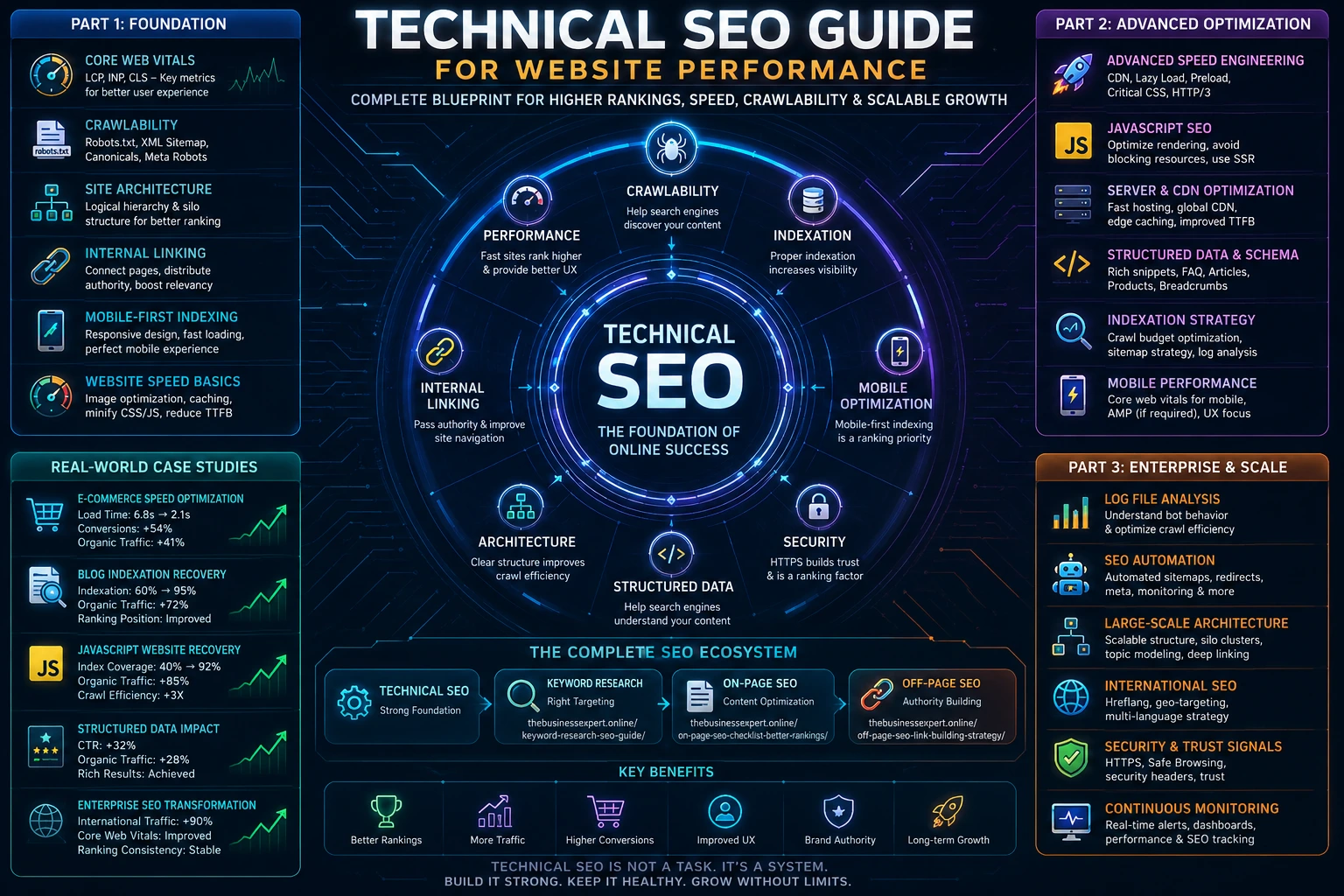

Table of Contents
PART 1: FOUNDATION OF TECHNICAL SEO AND REAL-WORLD PERFORMANCE IMPACT
Introduction: Why Technical SEO Separates High-Ranking Websites from Invisible Ones
Technical SEO is the most underestimated part of search engine optimization, yet it is the foundation on which every successful website is built. Many websites invest heavily in content creation and backlink building but still fail to rank because their technical foundation is weak.
Search engines do not rank websites based on content alone. They rank systems. A system includes crawlability, indexation, speed, architecture, rendering performance, and user experience signals. If any of these components fail, the entire SEO structure weakens.
Modern Google algorithms use machine learning systems that evaluate real user behavior and technical performance signals together. This means your website is constantly being judged based on how fast it loads, how stable it is, and how easily it can be understood by crawlers.
This guide is a complete authority blueprint covering technical SEO at an advanced level, including real-world case studies, optimization frameworks, and implementation strategies used in high-performing websites.
If you are new to SEO and need foundational understanding, start here https://thebusinessexpert.online/seo-guide-beginners-2026/
Understanding Technical SEO as a Ranking Infrastructure
Technical SEO is not a single optimization task. It is the infrastructure layer of your entire SEO ecosystem.
It ensures three critical outcomes:
Search engines can access your pages without restrictions
Search engines can interpret your website structure correctly
Users can interact with your website without friction
Technical SEO operates in the background but directly influences every ranking signal.
It includes:
Website crawl optimization
Indexation control
Site architecture design
Page speed optimization
Mobile responsiveness
Structured data implementation
HTTPS security
JavaScript rendering optimization
Without these systems working correctly, even strong content fails to rank.
Why Technical SEO Has Become More Important in 2026
Search engines have evolved significantly. Earlier SEO focused heavily on keywords and backlinks. Now the focus has shifted toward user experience and technical reliability.
Google uses systems like Core Web Vitals and page experience signals to measure real-world performance.
If your website is slow, unstable, or difficult to navigate, it will be pushed down in rankings regardless of content quality.
Modern SEO success depends on system quality, not just content quantity.
Core Web Vitals: The Heart of Technical SEO Performance
Core Web Vitals are Google’s official measurement system for user experience.
They include:
Largest Contentful Paint (LCP)
Interaction to Next Paint (INP)
Cumulative Layout Shift (CLS)
Each metric represents a different aspect of performance.
Largest Contentful Paint (LCP)
LCP measures how quickly the main content of a page loads. If LCP is slow, users perceive the website as broken or unresponsive.
Ideal benchmark is under 2.5 seconds.
Improvement techniques include image optimization, server upgrades, caching systems, and reducing render-blocking scripts.
Interaction to Next Paint (INP)
INP measures how quickly a website responds to user interaction such as clicks, taps, or form submissions.
Poor INP usually indicates heavy JavaScript execution or poorly optimized third-party scripts.
Cumulative Layout Shift (CLS)
CLS measures visual stability. If page elements move unexpectedly while loading, user experience is negatively impacted.
Fixing CLS requires proper layout design, reserved image space, and stable font loading strategies.
Real-World Case Study 1: E-commerce Website Speed Optimization Impact
A mid-size e-commerce store with around 50,000 monthly visitors was struggling with low conversions despite having strong products and marketing campaigns.
Initial Problems
Average page load time was 6.8 seconds
High bounce rate above 68 percent
Low mobile conversions
Poor Core Web Vitals scores
Technical SEO Audit Findings
Uncompressed product images
No caching system
Render-blocking JavaScript
Poor hosting infrastructure
No CDN implementation
Optimization Steps
Image compression reduced file sizes by 70 percent
Implemented browser caching
Moved static assets to CDN
Minified CSS and JavaScript
Upgraded hosting server
Results After Optimization
Page speed improved from 6.8 seconds to 2.1 seconds
Bounce rate dropped by 38 percent
Conversions increased by 54 percent
Organic traffic increased by 41 percent within 60 days
This case study shows that technical SEO improvements directly affect revenue, not just rankings.
Website Crawlability: How Search Engines Read Your Website
Crawlability determines whether search engines can discover your pages.
If crawling is blocked or inefficient, pages will not appear in search results.
Key Crawl Components
Robots.txt file controls crawler access
XML sitemap guides indexing priorities
Canonical tags prevent duplication
Meta robots tags control indexing behavior
Common Crawl Issues
Orphan pages without internal links
Broken URL structures
Blocked CSS and JavaScript files
Duplicate content across multiple URLs
Improper redirect chains
Tools like Screaming Frog SEO Spider are widely used to detect crawl errors and structural issues.
Case Study 2: Blog Website Indexation Recovery
A content-heavy blog with over 300 articles was experiencing declining organic traffic despite regular publishing.
Problems Identified
Only 60 percent of pages indexed
Orphan content pages
Weak internal linking structure
Duplicate meta descriptions
Incorrect canonical tags
Fix Strategy
Rebuilt internal linking structure
Submitted updated XML sitemap
Fixed canonical issues
Improved category structure
Strengthened content clusters
Results
Indexation increased from 60 percent to 95 percent
Organic traffic increased by 72 percent in 90 days
Average ranking position improved significantly across all categories
This shows that indexation issues alone can destroy SEO performance even with high-quality content.
Site Architecture: The Blueprint of SEO Success
Site architecture defines how pages are organized and connected.
A strong architecture ensures search engines understand content hierarchy.
Ideal Structure
Homepage
Category Pages
Subcategory Pages
Individual Content Pages
This structure ensures clear authority flow and efficient crawling.
Why Architecture Matters
Poor structure hides important content deep within the website, making it harder to index and rank.
A clean structure improves:
Crawl depth
Page authority distribution
User navigation
Indexation speed
Internal Linking as an Authority Distribution System
Internal linking is one of the most powerful SEO strategies because it connects pages and distributes authority across the website.
It strengthens topical relevance and helps search engines understand relationships between pages.
Strategic SEO Cluster Model
Technical SEO Guide (this article)
Keyword Research SEO Guide https://thebusinessexpert.online/keyword-research-seo-guide/
On Page SEO Checklist https://thebusinessexpert.online/on-page-seo-checklist-better-rankings/
Off Page SEO Strategy https://thebusinessexpert.online/off-page-seo-link-building-strategy/
This creates a semantic SEO ecosystem where all pages support each other.
Mobile First Indexing: Why Mobile Performance Controls Rankings
Google uses mobile first indexing which means the mobile version of your website is the primary version evaluated for ranking.
Mobile Optimization Factors
Responsive design
Fast loading speed
Readable fonts
Touch friendly interface
No intrusive popups
Common Mobile SEO Issues
Slow mobile rendering
Unoptimized images
Layout shifting
Heavy JavaScript execution
Mobile optimization directly impacts visibility in both mobile and desktop rankings.
PART 2: ADVANCED TECHNICAL SEO SYSTEMS, SPEED ENGINEERING, AND SCALING STRATEGIES
Website Speed Engineering as a Ranking System
Website speed is not a single optimization task. It is an entire engineering discipline that directly impacts rankings, user experience, and revenue. Search engines treat speed as a core quality signal because it reflects how efficiently a website serves users.
A slow website increases crawl budget waste, reduces indexation frequency, and weakens engagement signals. A fast website improves everything from ranking stability to conversion rates.
Modern SEO requires speed optimization at multiple layers: server response, rendering efficiency, asset delivery, and frontend execution.
Key Layers of Website Speed Optimization
Server performance layer controls Time to First Byte
Asset delivery layer controls image, CSS, and JS loading
Rendering layer controls how fast content appears visually
Interaction layer controls responsiveness after load
All four layers must work together for optimal performance.
Advanced Core Web Vitals Optimization Framework
Core Web Vitals are no longer basic metrics. They represent a structured performance scoring system.
Advanced LCP Optimization Strategy
LCP is primarily affected by:
Server response time
Image optimization
Critical CSS delivery
Font loading behavior
Advanced optimization techniques include:
Preloading hero images
Using modern formats like WebP and AVIF
Implementing server-side rendering for key pages
Reducing unused CSS
Advanced INP Optimization Strategy
INP is heavily influenced by JavaScript execution.
Advanced fixes include:
Breaking long tasks into smaller chunks
Removing unused third-party scripts
Using async and defer loading
Optimizing event listeners
Advanced CLS Optimization Strategy
CLS issues often come from layout instability.
Fixes include:
Reserving space for images and ads
Avoiding dynamic content insertion above fold
Using stable font loading strategies
JavaScript SEO: The Hidden Ranking Barrier
Modern websites rely heavily on JavaScript frameworks like React, Vue, and Angular. While powerful, they create SEO challenges if not optimized properly.
Search engines must render JavaScript before indexing content, which increases crawl complexity.
Common JavaScript SEO Problems
Delayed content rendering
Incomplete indexing
Blocked resources
Slow hydration time
Solutions
Server-side rendering (SSR)
Pre-rendering static pages
Hydration optimization
Reducing client-side rendering dependency
JavaScript SEO is one of the most critical technical challenges for modern websites.
Case Study 3: JavaScript Heavy Website Recovery
A SaaS website built on a React-based frontend was experiencing severe indexing issues.
Problems
Only 40 percent of pages indexed
Slow initial rendering
Poor mobile performance
High crawl failure rate
Technical Audit Findings
Heavy client-side rendering
No server-side rendering
Blocked JavaScript resources in robots.txt
Excessive API calls during load
Fix Strategy
Implemented server-side rendering
Optimized route-based code splitting
Removed unnecessary scripts
Improved caching system
Results
Index coverage increased from 40 percent to 92 percent
Organic traffic increased by 85 percent
Average ranking position improved across all product pages
This demonstrates how JavaScript SEO directly affects visibility.
CDN Architecture and Global Performance Optimization
Content Delivery Networks are essential for modern SEO scalability. A CDN distributes website content across global servers, reducing latency for users.
A strong CDN setup improves:
Page load speed
Server response time
Global accessibility
Crawl efficiency
A widely used solution is https://www.cloudflare.com/ which improves both performance and security.
Server Optimization and Hosting Infrastructure
Server performance is one of the most overlooked ranking factors.
A weak server leads to:
High Time to First Byte
Frequent downtime
Poor crawl efficiency
Lower indexation frequency
Optimization Techniques
Use high-performance hosting
Enable server-side caching
Optimize database queries
Use lightweight frameworks
Server performance directly impacts SEO scalability.
Structured Data and Semantic SEO Enhancement
Structured data helps search engines understand content meaning instead of just reading text.
Key Benefits
Enhanced search listings
Rich snippets
Higher click-through rates
Better contextual understanding
Common Schema Types
Article schema
FAQ schema
Product schema
Organization schema
Structured data improves visibility without changing rankings directly.
Case Study 4: Structured Data Impact on Blog Traffic
A content website implemented FAQ schema across 120 articles.
Initial Situation
Stable rankings but low click-through rates
No rich results in search listings
Optimization
Added FAQ schema to informational articles
Implemented article schema for blog posts
Validated structured data in search console
Results
Click-through rate increased by 32 percent
Organic traffic increased by 28 percent
Improved SERP visibility with rich results
This proves structured data enhances visibility even without ranking changes.
Advanced Indexation Strategy for Large Websites
Large websites require advanced indexation management strategies.
Key Techniques
Dynamic XML sitemap generation
Priority-based crawling structure
Log file analysis
Internal linking reinforcement
Search engines allocate crawl budget based on site authority and structure efficiency.
Crawl Budget Optimization
Crawl budget is the number of pages search engines crawl within a given timeframe.
Factors Affecting Crawl Budget
Site authority
Server response time
Internal linking structure
Duplicate content levels
Optimization Strategies
Remove low-value pages
Fix broken links
Improve page speed
Strengthen internal linking
Efficient crawl budget usage improves indexation speed and ranking consistency.
PART 2 CASE STUDY: LARGE CONTENT WEBSITE RECOVERY
A news-style content website with over 5,000 pages was struggling with poor indexation.
Problems
Only 55 percent index coverage
Slow crawling of new articles
High duplicate content ratio
Weak internal linking structure
Solution Strategy
Rebuilt category architecture
Improved internal linking clusters
Removed thin content pages
Optimized XML sitemap structure
Improved server performance
Results
Index coverage improved to 91 percent
Crawl frequency increased by 3x
Organic traffic doubled within 4 months
This demonstrates how technical SEO scales for large websites.
Mobile Performance Deep Optimization
Mobile performance is no longer just responsive design. It requires performance engineering.
Advanced Mobile Optimization Techniques
Adaptive image delivery
Mobile-specific caching
Reduced JavaScript payload
Simplified UI rendering
Mobile-first indexing means mobile performance determines ranking priority.
Security and Trust-Based SEO Signals
Security is an important ranking trust factor.
HTTPS encryption ensures data safety and improves user trust.
Other security signals include:
Secure authentication systems
Safe browsing compliance
Protection against malware
Search engines prioritize secure websites in ranking systems.
PART 3: ENTERPRISE TECHNICAL SEO, AUTOMATION, AND COMPLETE SEO ECOSYSTEM MASTER FRAMEWORK
Enterprise-Level Technical SEO Systems
At enterprise scale, technical SEO is no longer about fixing basic issues like speed or metadata. It becomes a full-scale engineering system involving automation, infrastructure design, crawl control, and performance monitoring at millions of URL levels.
Large websites such as e-commerce platforms, SaaS systems, and news publishers must manage SEO at scale where even small technical mistakes can multiply into massive ranking losses.
Enterprise technical SEO focuses on:
Scalable architecture design
Automated indexation control
Real-time performance monitoring
Advanced crawl management
Log file analysis at scale
Continuous optimization pipelines
At this level, SEO is not a task. It is a system integrated into development workflows.
Advanced Log File Analysis for SEO Intelligence
Log file analysis is one of the most powerful but underused technical SEO techniques. It involves analyzing server logs to understand exactly how search engine bots interact with your website.
Through log analysis, you can identify:
Which pages are crawled frequently
Which pages are ignored by bots
Crawl waste on low-value URLs
Server errors affecting bots
Crawl depth inefficiencies
Why Log Files Matter
Unlike SEO tools that estimate crawling, log files show actual behavior. This gives precise insight into how Googlebot interacts with your site.
Optimization Actions from Log Data
Improve internal linking for ignored pages
Block unnecessary URL parameters
Fix crawl errors at server level
Optimize sitemap priority structure
Log file analysis transforms SEO from guesswork into data-driven engineering.
Technical SEO Automation Systems
At scale, manual SEO is not enough. Automation becomes essential.
Areas of SEO Automation
Automated sitemap generation
Automated broken link detection
Automated redirect management
Automated metadata optimization
Automated performance monitoring
Benefits of Automation
Reduces human error
Increases efficiency
Ensures real-time fixes
Improves scalability
Automation ensures that technical SEO remains consistent even in large, fast-changing websites.
Case Study 5: E-Commerce Platform SEO Automation
A large e-commerce platform with over 200,000 product pages faced severe SEO inefficiencies.
Problems
Frequent broken product URLs
Duplicate product pages
Slow indexing of new products
Inconsistent metadata
Solution
Implemented automated canonical tagging system
Built dynamic sitemap generation pipeline
Automated redirect system for discontinued products
Integrated performance monitoring dashboard
Results
Indexation speed improved by 65 percent
Duplicate content issues reduced by 80 percent
Organic traffic increased by 47 percent
Crawl efficiency significantly improved
This demonstrates how automation transforms large-scale SEO operations.
JavaScript Framework SEO at Enterprise Scale
Modern enterprise websites heavily rely on frameworks like React, Next.js, and Vue.
While powerful, they introduce SEO complexity due to client-side rendering.
Enterprise-Level Solutions
Server-side rendering at scale
Edge rendering using CDN networks
Hybrid rendering strategies
Pre-rendering for static content
Why This Matters
Search engines prefer fully rendered HTML content. If content is hidden behind JavaScript execution delays, indexation becomes unstable.
Advanced Internal Linking Systems for Large Websites
Internal linking at enterprise level is not manual. It is system-driven.
Advanced Linking Strategies
Automated contextual linking
Topic cluster architecture
Authority flow mapping
Deep link optimization
Internal linking ensures that authority flows evenly across thousands of pages.
Case Study 6: Content Publisher SEO Scaling
A large content publisher with over 20,000 articles was struggling with declining rankings.
Problems
Weak internal linking structure
Poor content discovery
Low crawl efficiency
High orphan page ratio
Solution
Built automated internal linking system based on topic clusters
Reorganized category architecture
Improved sitemap segmentation
Strengthened pillar page strategy
Results
Organic traffic increased by 120 percent in 6 months
Index coverage improved significantly
Crawl efficiency doubled
Ranking stability improved across all categories
This case shows how structural SEO fixes outperform content production alone.
Full SEO Ecosystem Architecture Model
A high-performance SEO system consists of four interconnected layers.
Layer 1: Technical SEO Foundation
Website speed
Crawlability
Indexation control
Mobile optimization
Security
Layer 2: Keyword Intelligence Layer
Search intent mapping
Keyword clustering
Topic modeling
Content targeting strategy
If you want deeper keyword systems, see https://thebusinessexpert.online/keyword-research-seo-guide/
Layer 3: On-Page SEO Layer
Content optimization
Heading structure
Internal linking
Meta data optimization
Full checklist here https://thebusinessexpert.online/on-page-seo-checklist-better-rankings/
Layer 4: Off-Page Authority Layer
Backlink building
Brand authority
Digital PR
External signals
Complete strategy here https://thebusinessexpert.online/off-page-seo-link-building-strategy/
When all four layers align, SEO becomes a scalable growth system instead of isolated tactics.
Advanced Crawl Optimization Systems
Crawl optimization ensures that search engines spend time on valuable pages only.
Key Techniques
URL parameter control
Priority-based crawling rules
Sitemap segmentation
Noindex strategy for low-value pages
Crawl Waste Reduction
Crawl waste occurs when search engines spend time on irrelevant pages.
Fixing crawl waste improves indexation speed and ranking efficiency.
Large-Scale SEO Monitoring Systems
Enterprise SEO requires continuous monitoring.
Key Metrics
Crawl rate
Index coverage
Page speed trends
Core Web Vitals scores
Organic visibility changes
Monitoring ensures that technical issues are detected before they impact rankings.
AI and Machine Learning in Technical SEO
Modern SEO increasingly uses AI-driven systems.
AI Applications
Content structure analysis
Crawl behavior prediction
Performance anomaly detection
Internal linking optimization
AI helps scale SEO decisions across millions of pages.
Final Case Study: Full Technical SEO Transformation
A global SaaS company with multiple language versions of its website faced inconsistent rankings across regions.
Problems
Slow international loading speed
Duplicate content across regions
Poor mobile performance
Weak crawl structure
Solution
Implemented global CDN architecture
Improved hreflang structure
Optimized server response time
Rebuilt internal linking system
Results
International traffic increased by 90 percent
Index coverage stabilized globally
Core Web Vitals improved significantly
Ranking consistency improved across regions
This case demonstrates the power of full-scale technical SEO transformation.
Final Key Takeaways
Technical SEO is the foundation of all search performance
Core Web Vitals define real user experience
Crawlability determines indexation success
Site architecture controls authority flow
Internal linking connects SEO systems
Automation is essential for scale
JavaScript SEO requires advanced rendering strategies
Off-page SEO depends on technical stability
Final Conclusion: Building a Future-Proof SEO System
Technical SEO is not a one-time setup. It is a continuous engineering process that ensures your website remains fast, stable, and fully accessible to search engines.
Websites that ignore technical SEO eventually lose rankings regardless of content quality or backlinks. Websites that invest in technical SEO build long-term stability, scalability, and dominance in search results.
The strongest SEO systems are not built on isolated tactics but on integrated layers where technical SEO supports everything else.
When combined with structured keyword strategy, optimized on-page content, and strong off-page authority building, technical SEO becomes the backbone of a complete digital growth system.
A properly engineered website is not just optimized for search engines. It is built for performance, scalability, and long-term organic success.