
Table of Contents
Introduction
Search behavior is changing faster than most marketers expected. For years, traditional SEO focused on ranking web pages in search engine results. Businesses optimized content for keywords, backlinks, metadata, and technical performance to attract clicks from platforms like Google Google.
Now, artificial intelligence is reshaping how people discover information online.
Users increasingly expect direct answers instead of scrolling through multiple links. AI-powered assistants, conversational search engines, voice search systems, and generative AI platforms are changing how content gets surfaced and consumed. This transformation has introduced a new optimization strategy rapidly gaining attention across digital marketing: AEO.
AEO, or Answer Engine Optimization, focuses on optimizing content for AI-driven answer systems rather than traditional search result rankings alone.
For marketers, publishers, business owners, and SEO professionals, understanding the difference between SEO and AEO is becoming essential. Businesses that adapt early can position themselves for long-term visibility in AI-powered search ecosystems. Those that ignore the shift may lose traffic, authority, and discoverability as search evolves.
This article explains AEO vs SEO in depth, how both strategies work, how AI search changes optimization, what marketers must prioritize moving forward, and how businesses can future-proof their digital visibility strategies.
What Is SEO?
SEO stands for Search Engine Optimization.
SEO is the process of improving a website’s visibility in search engine results pages (SERPs).
Traditional SEO focuses on helping web pages rank higher for relevant keywords and search queries.
SEO typically involves:
- Keyword optimization
- Content creation
- Technical improvements
- Link building
- Site structure optimization
- User experience improvements
- Mobile optimization
- Search intent alignment
The goal is to increase organic traffic from search engines.
A comprehensive Complete SEO Guide for Beginners explains how traditional SEO systems work and why they remain important even as AI search evolves.
What Is AEO?
AEO stands for Answer Engine Optimization.
AEO focuses on optimizing content so AI systems and answer engines can easily extract, understand, and present direct answers to users.
Instead of optimizing only for rankings and clicks, AEO aims to position content as the best answer source for:
- AI search summaries
- Voice assistants
- Conversational AI systems
- Featured snippets
- AI-generated responses
- Smart assistants
AEO is becoming increasingly important because users now interact with search systems conversationally.
Examples include:
- “What is the best SEO strategy for small businesses?”
- “How does Google AI search work?”
- “What’s the difference between AEO and SEO?”
AI systems attempt to provide immediate answers rather than simply displaying web links.
Why AEO Is Growing Rapidly
Several major trends are accelerating AEO adoption.
Rise of AI Search
AI-powered search experiences are expanding rapidly.
Platforms like:
- Google SGE
- AI assistants
- Voice search tools
- Conversational search engines
are changing search behavior dramatically.
Businesses adapting to AI search should understand How Google SGE (AI Search) Works because generative search is fundamentally reshaping online visibility.
Growth of Voice Search
Users increasingly use conversational voice queries through smart devices.
Zero-Click Searches
Many users now receive answers directly inside search interfaces without clicking websites.
AI Content Summaries
Search engines increasingly summarize content automatically using generative AI.
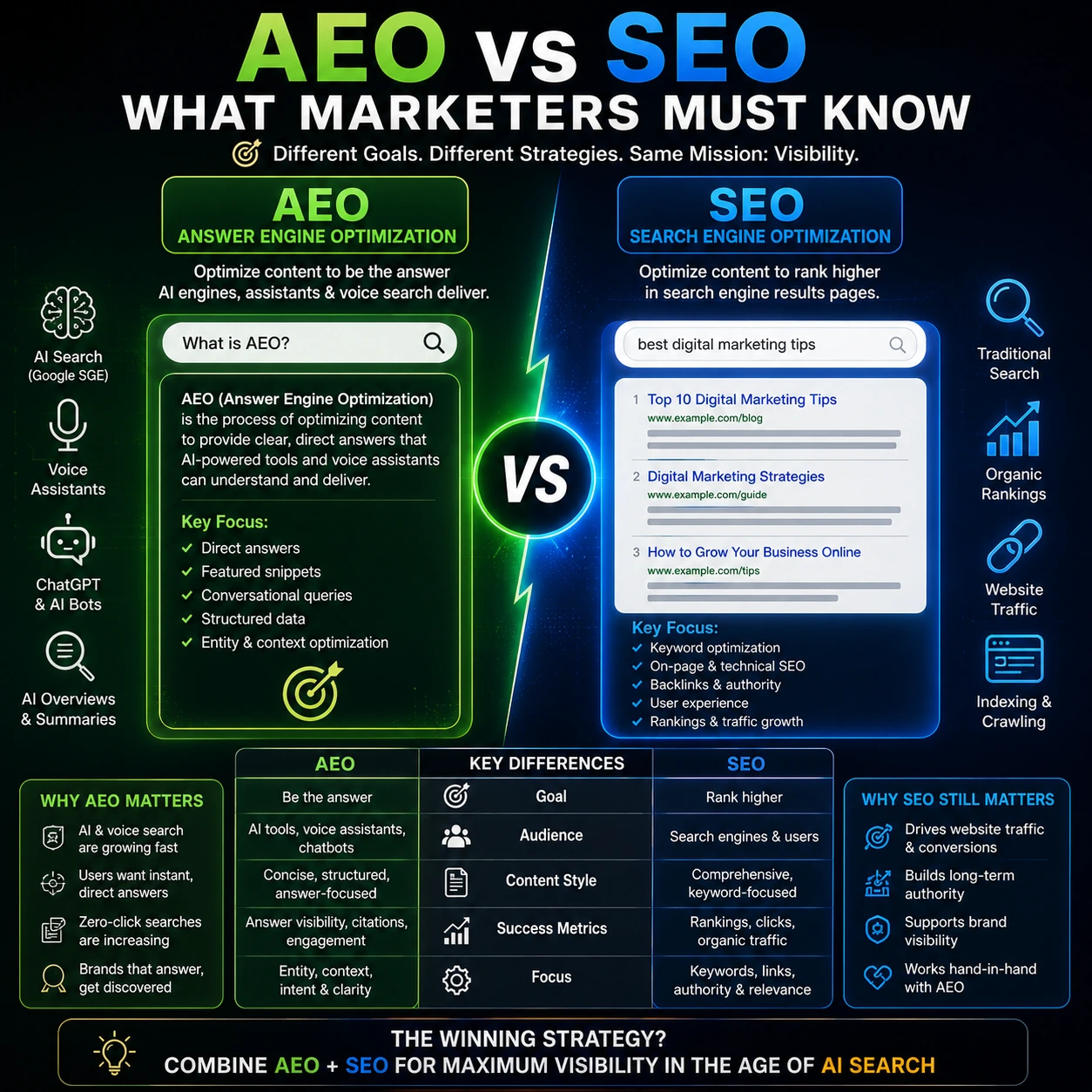
Key Difference Between AEO and SEO
Although SEO and AEO overlap significantly, their primary goals differ.
| Factor | SEO | AEO |
|---|---|---|
| Primary Goal | Rank web pages | Provide direct answers |
| Focus | Search rankings | AI answer extraction |
| Traffic Strategy | Website clicks | Visibility in answers |
| Optimization Style | Keywords and rankings | Context and concise answers |
| User Behavior | Browsing search results | Conversational interaction |
| Search Environment | Traditional SERPs | AI-driven interfaces |
| Success Metric | Organic traffic | Answer visibility |
| Content Structure | Long-form optimized pages | Structured answer-friendly content |
How Traditional SEO Works
Traditional SEO involves optimizing websites around search engine ranking algorithms.
Keyword Research
SEO identifies keywords users search for frequently.
A powerful Keyword Research Guide explains how businesses identify search demand and ranking opportunities.
On-Page Optimization
This includes:
- Title tags
- Meta descriptions
- Headers
- Internal links
- Content optimization
A detailed On-Page SEO Guide covers modern optimization techniques for improving search visibility.
Technical SEO
Technical SEO improves:
- Site speed
- Crawlability
- Mobile usability
- Structured data
- Core Web Vitals
A strong Technical SEO Guide remains essential even in AI-driven search environments.
Off-Page SEO
Off-page SEO builds authority through:
- Backlinks
- Mentions
- Brand signals
- Citations
An advanced Off-Page SEO Guide explains how authority signals influence rankings.
How AEO Works
AEO focuses on making content easy for AI systems to understand and extract.
Structured Answers
AEO prioritizes concise, direct responses to common questions.
Conversational Language
Content is optimized around natural language queries.
Entity Optimization
AI systems rely heavily on contextual entities and relationships.
Semantic Relevance
AEO focuses more on meaning and context than exact keywords.
Structured Data
Schema markup helps AI systems understand content relationships.
How AI Search Is Changing Optimization
AI search changes the entire structure of online discovery.
Search Becomes Conversational
Users increasingly search using full questions instead of short phrases.
Traditional query:
“best laptops”
Conversational AI query:
“What’s the best laptop for college students under $1000?”
Context Matters More
AI systems analyze:
- Intent
- Meaning
- User context
- Relationships between concepts
Featured Answers Gain Importance
Visibility increasingly depends on becoming the selected answer source.
Authority Signals Grow Stronger
AI systems prefer trustworthy sources with expertise and credibility.
The broader discussion around whether ChatGPT will replace Google Search highlights how AI-driven information discovery is reshaping search ecosystems.
Why SEO Still Matters
Despite AI advancements, SEO is far from dead.
Search Engines Still Use Indexing Systems
AI search relies heavily on traditional search indexes.
Websites Remain Core Information Sources
AI systems still pull information from websites.
Technical SEO Still Impacts Visibility
Poor technical performance limits discoverability.
Organic Traffic Still Drives Revenue
Businesses still depend heavily on search traffic for:
- Leads
- Sales
- Brand awareness
- Conversions
Why AEO Matters More Than Ever
AEO helps businesses remain visible inside AI-powered search systems.
AI Systems Prefer Structured Information
Clear, concise answers improve extraction probability.
Voice Search Continues Expanding
Voice assistants rely heavily on direct-answer systems.
Featured Snippets Influence AI Answers
Featured snippet optimization supports AEO visibility.
Conversational Search Is Increasing
Users increasingly interact with search conversationally.
SEO vs AEO Content Structure
Traditional SEO Content
SEO articles often focus on:
- Comprehensive depth
- Keyword optimization
- Long-form structure
- Topic authority
AEO-Optimized Content
AEO content emphasizes:
- Direct answers
- Clear formatting
- Concise explanations
- Question-based headings
- Structured information
The best modern content strategies combine both.
Best Practices for AEO
Answer Questions Clearly
Use concise and direct responses early in content sections.
Use Question-Based Headings
Examples include:
- What is AEO?
- How does AI search work?
- Why is AEO important?
Add Structured Data
Schema markup improves machine readability.
Improve Readability
Use:
- Bullet points
- Short paragraphs
- Tables
- Lists
- Clear formatting
Focus on Semantic Relevance
Optimize around topics and context instead of repeating exact keywords.
Best Practices for SEO
Build Topical Authority
Cover subjects comprehensively.
Optimize Internal Linking
Strong site architecture improves rankings.
Improve Technical Performance
Fast, mobile-friendly websites perform better.
Earn High-Quality Backlinks
Authority remains a major ranking factor.
Match Search Intent
Content should directly satisfy user needs.
Businesses targeting local discovery should also explore Local SEO optimization strategies for improving visibility in geographically targeted searches.
How AEO and SEO Work Together
AEO does not replace SEO.
Instead, AEO expands SEO strategies into AI-powered search environments.
Modern optimization now requires:
- Traditional SEO foundations
- AI-answer optimization
- Conversational relevance
- Semantic structuring
- Authority building
Businesses that integrate both approaches gain stronger long-term visibility.
The Role of AI Content in AEO
AI-generated content is becoming common across digital publishing.
However, AI-generated content alone does not guarantee visibility.
Businesses should understand the differences between AI Content vs Human Content for SEO because AI systems increasingly prioritize expertise, originality, and trustworthiness.
Common Mistakes
Focusing Only on Keywords
Modern optimization requires contextual understanding.
Ignoring Conversational Search
Natural-language optimization is increasingly important.
Publishing Thin Content
Low-value pages struggle in both SEO and AEO environments.
Weak Site Structure
Poor organization limits crawlability and answer extraction.
Neglecting Structured Data
Schema markup helps AI systems interpret content accurately.
Ignoring User Experience
Poor UX reduces engagement and trust signals.
Businesses should avoid the issues covered in this Common SEO Mistakes Guide to strengthen both SEO and AEO performance.
Advanced Strategies
Build Entity-Based SEO
Optimize around entities, topics, and relationships.
Create FAQ Ecosystems
FAQ structures improve answer extraction opportunities.
Use Conversational Keyword Mapping
Target question-based search patterns.
Improve Information Gain
Create unique insights instead of repeating generic information.
Strengthen Brand Authority
Strong brands increasingly influence AI answer selection.
Combine SEO and AEO Analytics
Track both traffic performance and answer visibility.
Key Metrics To Track
Organic Traffic
Monitor:
- Search visits
- Landing pages
- Traffic growth
Featured Snippet Visibility
Track snippet acquisition opportunities.
AI Search Mentions
Measure AI-generated visibility where possible.
User Engagement
Important metrics include:
- Time on page
- Scroll depth
- Bounce rate
Conversion Metrics
Track:
- Leads
- Purchases
- Signups
- Revenue attribution
Technical SEO Health
Monitor:
- Site speed
- Core Web Vitals
- Crawl errors
- Mobile usability
Useful SEO Tools for Beginners can simplify performance tracking and optimization analysis.
Key Takeaways
- SEO focuses on ranking websites in search engines.
- AEO focuses on optimizing content for AI-generated answers.
- AI search is rapidly changing user behavior and content discovery.
- Conversational optimization is becoming increasingly important.
- Structured content improves answer extraction opportunities.
- Technical SEO still matters in AI-driven search ecosystems.
- Authority and trust signals are becoming more important.
- SEO and AEO work best when combined strategically.
- Businesses should optimize for both search engines and answer engines.
- High-quality user-focused content remains the foundation of visibility.
Frequently Asked Questions
What is the difference between SEO and AEO?
SEO focuses on ranking pages in search results, while AEO focuses on optimizing content for AI-generated answers and conversational search systems.
Is AEO replacing SEO?
No. AEO complements SEO rather than replacing it.
Why is AEO becoming important?
AI-powered search systems and conversational assistants are changing how users access information online.
Does Google use AEO?
Google increasingly uses AI-generated summaries and answer systems within search experiences.
How can businesses optimize for AEO?
Businesses should focus on structured content, concise answers, conversational language, and semantic relevance.
Does structured data help AEO?
Yes. Schema markup improves machine understanding and answer extraction.
Is keyword optimization still important?
Yes, but modern optimization also requires contextual and semantic relevance.
What content works best for AEO?
Clear, well-structured, authoritative, and question-focused content performs best.
Does voice search impact AEO?
Absolutely. Voice search relies heavily on answer-engine systems.
Can businesses use both SEO and AEO together?
Yes. The strongest strategies combine traditional SEO with AI-answer optimization.
Conclusion
The evolution of AI-powered search is transforming digital marketing faster than many businesses anticipated. Traditional SEO remains essential, but it is no longer enough on its own.
AEO introduces a new layer of optimization designed for conversational AI systems, voice assistants, generative search experiences, and direct-answer platforms. As users increasingly expect immediate and contextual responses, businesses must adapt their content strategies accordingly.
SEO still drives rankings, organic traffic, and discoverability. AEO improves visibility within AI-generated answers and conversational interfaces. Together, they form the foundation of modern search optimization.
Businesses that embrace both strategies will be better positioned to compete in the future of AI-powered discovery. Those that focus only on outdated keyword-based optimization may struggle as search engines continue evolving toward smarter, more conversational experiences.
The future of visibility belongs to brands that create trustworthy, structured, experience-driven content optimized for both humans and intelligent search systems.