
Table of Contents
Introduction
Search behavior is changing faster than most businesses realize. Traditional SEO is no longer the only path to online visibility. AI-powered search engines, generative search experiences, conversational assistants, and answer engines are transforming how users discover information online. Instead of scrolling through ten blue links, users now receive direct AI-generated answers pulled from multiple trusted sources.
This shift is creating a new competitive landscape. Websites that once ranked well on Google may struggle to appear inside AI-generated summaries, while smaller authority sites with highly structured, trustworthy, and context-rich content can suddenly gain massive visibility.
Ranking in AI search results requires a different mindset. Standard keyword optimization alone is no longer enough. AI systems evaluate topical authority, semantic relevance, entity relationships, user intent satisfaction, structured information, trust signals, and content depth simultaneously. They prioritize content that delivers complete answers quickly while maintaining credibility and clarity.
For businesses, publishers, marketers, and SEO professionals, understanding how AI search works has become critical for long-term organic growth. Brands that adapt early can secure visibility across AI Overviews, generative search engines, conversational AI platforms, and future search ecosystems before competition intensifies.
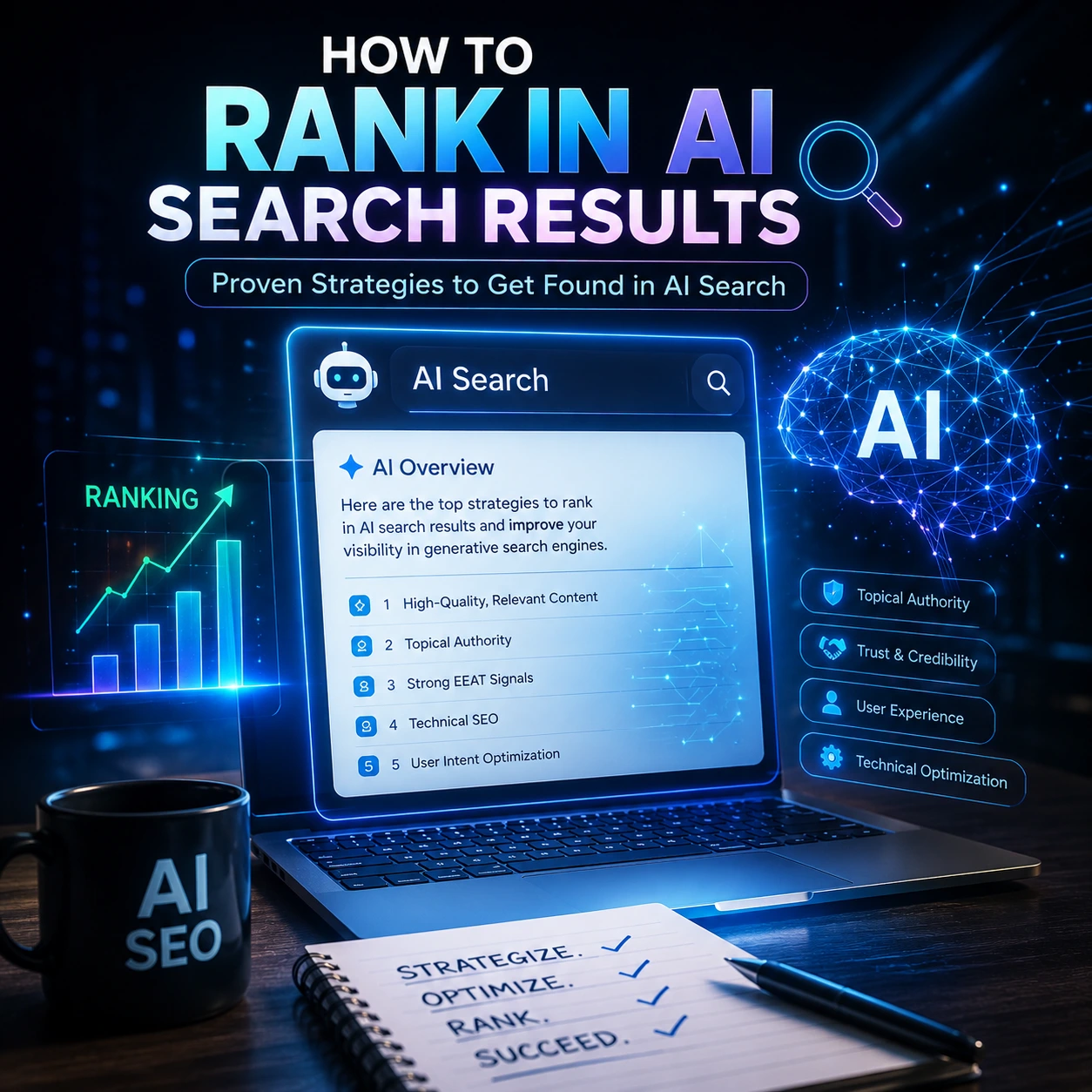
This guide explains exactly how to rank in AI search results in 2026 and beyond. You will learn how AI search engines evaluate content, which ranking factors matter most, how to optimize content architecture, what technical improvements influence AI visibility, and how to build a sustainable AI SEO strategy that survives future algorithm shifts.
Understanding AI Search Results
AI search results differ significantly from traditional search engine rankings. Instead of displaying a list of websites only, AI-powered systems synthesize information from multiple sources and generate direct responses for users.
Modern AI search ecosystems include:
- Google AI Overviews
- Generative search engines
- Conversational AI assistants
- AI-powered voice search
- Large language model integrations
- Contextual recommendation systems
To understand the future of search behavior, explore how AI-driven search systems are evolving in this detailed guide about how Google SGE AI search works:
https://thebusinessexpert.online/how-google-sge-ai-search-works/
How AI Search Engines Process Content
AI systems evaluate websites differently compared to traditional algorithms. Instead of focusing primarily on exact-match keywords, AI models analyze:
- Semantic meaning
- Context relationships
- Topical depth
- User intent fulfillment
- Entity associations
- Content structure
- Authority signals
- Trustworthiness
- Content freshness
- Technical accessibility
This means content creators must optimize for comprehension rather than just rankings.
Why AI Search Optimization Matters
Businesses ignoring AI search optimization risk losing substantial organic visibility over the next few years.
Key reasons include:
- AI-generated answers reduce traditional click-through behavior.
- Featured AI responses dominate above-the-fold visibility.
- Voice and conversational search continue growing.
- AI systems increasingly influence purchase decisions.
- User expectations now prioritize instant answers.
Brands that appear consistently in AI-generated responses gain:
- Higher authority perception
- Increased trust
- Better brand recognition
- Improved organic visibility
- Greater long-term traffic stability
How AI Search Ranking Works
AI search systems combine multiple technologies simultaneously.
Natural Language Understanding
AI models analyze the actual meaning behind user queries rather than simply matching keywords.
For example:
Traditional SEO query:
“best seo tools beginners”
AI interpretation:
“What affordable SEO tools provide the most value for beginners learning search optimization?”
This is why semantic relevance matters more than exact-match optimization.
For deeper keyword optimization strategies, review this complete keyword research SEO guide:
https://thebusinessexpert.online/keyword-research-seo-guide/
Entity-Based Search
Modern AI search engines rely heavily on entities.
Entities include:
- People
- Brands
- Products
- Concepts
- Organizations
- Locations
- Technologies
AI systems connect relationships between entities to understand expertise and authority.
For example, if your site frequently covers:
- SEO
- AI search
- Google algorithms
- Content marketing
- Technical optimization
AI systems begin associating your domain with search expertise.
Contextual Relevance
AI systems prioritize contextual completeness instead of isolated keyword targeting.
Strong AI-optimized content answers:
- What
- Why
- How
- When
- Who
- Benefits
- Risks
- Comparisons
- Use cases
- Next steps
Pages missing contextual depth are less likely to appear in AI-generated answers.
Core Ranking Factors for AI Search Results
Topical Authority
Topical authority has become one of the strongest AI ranking signals.
Instead of publishing random unrelated articles, build tightly connected topic clusters.
Example AI SEO cluster:
| Pillar Topic | Supporting Content |
|---|---|
| AI SEO | AI content optimization |
| AI SEO | AI search ranking factors |
| AI SEO | Technical SEO for AI |
| AI SEO | AI Overviews optimization |
| AI SEO | Entity SEO strategies |
This structure helps AI systems understand subject expertise.
For broader SEO foundations, review this beginner-friendly SEO guide:
https://thebusinessexpert.online/seo-guide-beginners-2026/
Content Depth
Thin content struggles in AI search ecosystems.
AI systems favor:
- Comprehensive guides
- Detailed explanations
- Original insights
- Real examples
- Structured content
- Multi-angle coverage
High-performing AI search content often exceeds 2,500–4,000 words when topic complexity requires depth.
EEAT Signals
Experience, Expertise, Authoritativeness, and Trustworthiness remain highly important.
AI systems evaluate:
- Author credibility
- Site reputation
- Content accuracy
- Citation consistency
- Brand trust
- Expertise signals
Ways to improve EEAT:
- Publish expert-driven content
- Add author information
- Maintain factual accuracy
- Update outdated content
- Build quality backlinks
- Improve brand visibility
Semantic Optimization
Semantic SEO helps AI systems fully understand content relationships.
Instead of repeating one keyword excessively, naturally include related concepts.
Example semantic keywords for AI search optimization:
- AI SEO
- generative search optimization
- answer engine optimization
- conversational search
- entity SEO
- semantic search optimization
- AI Overviews
- machine learning ranking systems
This improves contextual relevance naturally.
User Intent Satisfaction
AI systems prioritize pages that fully solve user problems.
Types of intent include:
- Informational
- Commercial
- Navigational
- Transactional
- Comparative
Your content should match search intent precisely.
Content Strategies for Ranking in AI Search
Write for Questions, Not Just Keywords
AI search engines heavily prioritize question-based content.
Examples:
- How does AI search work?
- What affects AI rankings?
- Why is semantic SEO important?
- How can websites appear in AI Overviews?
Question-focused content increases featured snippet opportunities.
Use Structured Headings
Clear hierarchy improves AI comprehension.
Recommended structure:
- H1 for primary topic
- H2 for major sections
- H3 for supporting subtopics
- H4 for detailed breakdowns
Well-structured content is easier for AI systems to parse.
Create Comprehensive Topic Clusters
One article alone rarely builds strong authority.
Create connected content ecosystems.
For example:
- AI SEO guide
- Technical SEO for AI
- AI content optimization
- AI vs traditional search
- AI keyword research
- AI visibility strategies
This strengthens semantic relationships.
Optimize for Featured Snippets
AI systems often pull concise answers from snippet-optimized sections.
Best practices:
- Use direct definitions
- Add numbered steps
- Include concise summaries
- Answer questions immediately
- Use tables where relevant
Example snippet format:
“How to rank in AI search results:
- Build topical authority
- Optimize semantic relevance
- Improve technical SEO
- Create structured content
- Strengthen trust signals”
Technical SEO for AI Search Visibility
Technical optimization remains foundational for AI rankings.
For deeper technical optimization insights, review this technical SEO guide:
https://thebusinessexpert.online/technical-seo-guide-website-performance-core-web-vitals/
Improve Crawlability
AI systems need efficient access to content.
Checklist:
- XML sitemap
- Clean internal linking
- Proper robots.txt
- Fast page loading
- Mobile optimization
- Structured navigation
Implement Schema Markup
Structured data helps AI systems interpret content more accurately.
Useful schema types:
- Article schema
- FAQ schema
- Organization schema
- Breadcrumb schema
- Author schema
Schema increases content clarity and AI discoverability.
Enhance Page Experience
User experience directly influences AI trust signals.
Important metrics include:
| Metric | Why It Matters |
|---|---|
| Page speed | Improves engagement |
| Mobile usability | Essential for indexing |
| Core Web Vitals | Affects UX quality |
| Bounce rate | Indicates satisfaction |
| Time on page | Reflects content value |
Strengthen Internal Linking
Internal linking improves contextual relationships.
Strategic internal links also help distribute authority naturally.
For example, readers exploring AI-driven SEO changes may benefit from understanding how AI is changing SEO in 2026:
https://thebusinessexpert.online/how-ai-is-changing-seo-in-2026/
AI Content Optimization Best Practices
Prioritize Human-First Writing
AI-generated low-value content rarely performs sustainably.
Search systems increasingly reward:
- Original thinking
- Expert insights
- Real experience
- Helpful explanations
- Clear structure
For a deeper comparison, review this guide on AI content vs human content for SEO:
https://thebusinessexpert.online/ai-content-vs-human-content-for-seo/
Improve Information Gain
Information gain means adding value unavailable elsewhere.
Ways to improve it:
- Share case studies
- Add proprietary frameworks
- Include expert analysis
- Present fresh insights
- Explain emerging trends
Use Conversational Language
AI search engines prefer natural language patterns.
Avoid:
- Awkward keyword repetition
- Robotic phrasing
- Over-optimization
Instead:
- Write naturally
- Use contextual flow
- Prioritize readability
Link Building for AI Search Rankings
Backlinks still matter significantly.
However, quality matters more than quantity.
For advanced off-page optimization methods, review this off-page SEO link building strategy:
https://thebusinessexpert.online/off-page-seo-link-building-strategy/
High-Value Link Sources
Strong links include:
- Industry publications
- Expert interviews
- Authority blogs
- Research mentions
- Trusted business directories
Brand Mentions Matter
AI systems increasingly analyze implied authority through mentions even without direct backlinks.
Build visibility through:
- Podcasts
- PR campaigns
- Expert contributions
- Social discussions
- Community engagement
Local SEO and AI Search
AI search increasingly personalizes results geographically.
Businesses should optimize:
- Google Business Profile
- Local citations
- Regional keywords
- Location-specific pages
- Local reviews
For regional optimization strategies, explore this local SEO guide:
https://thebusinessexpert.online/local-seo-guide/
Businesses targeting Pakistan-based audiences can also strengthen digital visibility through localized digital marketing strategies:
https://thebusinessexpert.online/digital-marketing-karachi/
Common Mistakes
Many websites fail to rank in AI search because they continue using outdated SEO practices.
Overusing Keywords
Keyword stuffing damages readability and contextual quality.
Publishing Thin Content
Short shallow articles lack sufficient informational depth.
Ignoring Technical SEO
Poor site structure weakens crawl efficiency.
Weak Internal Linking
Disconnected content reduces topical authority.
Relying Entirely on AI Writing
Unedited AI-generated content often lacks originality and expertise.
Neglecting Search Intent
Ranking becomes difficult when content does not match user expectations.
Ignoring User Experience
Slow, cluttered websites reduce engagement signals.
Advanced Strategies
Build Entity Authority
Repeatedly publish around connected topics.
This trains AI systems to associate your domain with expertise.
Optimize for Conversational Queries
AI search increasingly mirrors natural conversations.
Examples:
- “What is the best way to optimize for AI search?”
- “How do websites appear in AI-generated answers?”
Use conversational subheadings naturally.
Publish Original Research
Unique data dramatically improves citation potential.
Examples:
- Surveys
- Industry reports
- Case studies
- Benchmark analyses
Update Content Frequently
AI systems value freshness for evolving topics.
Regular updates improve:
- Accuracy
- Relevance
- Crawl frequency
- Visibility stability
Improve Brand Signals
Strong brands gain higher trust.
Build visibility through:
- Consistent publishing
- Expert positioning
- Media mentions
- Community engagement
Key Metrics To Track
Tracking AI SEO performance requires more than keyword rankings alone.
Important metrics include:
| Metric | Purpose |
|---|---|
| Organic traffic | Measures visibility growth |
| AI Overview appearances | Tracks AI exposure |
| Featured snippets | Indicates authority |
| Click-through rate | Measures SERP performance |
| Engagement rate | Reflects content quality |
| Time on page | Indicates usefulness |
| Returning visitors | Shows trust and value |
| Backlink growth | Measures authority expansion |
Key Takeaways
- AI search optimization focuses on context, authority, and user satisfaction.
- Semantic relevance matters more than keyword density.
- Topical authority significantly impacts AI visibility.
- Technical SEO remains essential.
- Structured content improves AI comprehension.
- Conversational optimization increases discoverability.
- Original insights strengthen ranking potential.
- Internal linking builds stronger contextual relevance.
- User experience directly influences AI trust signals.
- Long-term authority beats short-term manipulation.
Frequently Asked Questions
What is AI search optimization?
AI search optimization is the process of improving content, technical SEO, and authority signals to increase visibility in AI-generated search results and conversational search systems.
How is AI SEO different from traditional SEO?
Traditional SEO focused heavily on keywords and rankings, while AI SEO emphasizes semantic relevance, contextual understanding, topical authority, and user intent satisfaction.
Can small websites rank in AI search results?
Yes. Smaller websites with highly authoritative, well-structured, and trustworthy content can perform very well in AI search ecosystems.
Does keyword research still matter for AI SEO?
Yes, but modern keyword research focuses more on topics, intent, semantic relevance, and conversational queries rather than exact-match keywords alone.
Is technical SEO still important for AI rankings?
Absolutely. Crawlability, structured data, page speed, and mobile usability remain critical foundations for AI visibility.
Do backlinks still matter in AI search?
Yes. High-quality backlinks continue to influence authority and trust signals significantly.
How often should AI SEO content be updated?
Content covering evolving industries should be reviewed and updated regularly to maintain accuracy and freshness.
Does AI-generated content rank well?
AI-generated content can rank if heavily edited, improved with expert insights, and designed primarily for users rather than automation.
What are AI Overviews?
AI Overviews are AI-generated summaries displayed directly in search results that synthesize information from multiple trusted sources.
Will AI replace traditional Google search?
AI is transforming search behavior rather than completely replacing traditional search. Understanding this evolution is essential for future SEO success:
https://thebusinessexpert.online/will-chatgpt-replace-google-search/
Conclusion
Ranking in AI search results requires a complete evolution in SEO thinking. Search engines are becoming answer engines powered by artificial intelligence, semantic understanding, contextual relationships, and trust evaluation systems. Websites relying on outdated keyword-heavy tactics will continue losing visibility as AI-driven search experiences expand.
The future belongs to brands that build genuine topical authority, create deeply valuable content, optimize technical foundations, strengthen semantic relevance, and prioritize user satisfaction above manipulation tactics.
Success in AI search is not about gaming algorithms. It is about becoming the most trusted, comprehensive, and contextually valuable source within your niche.
Businesses that adapt early will gain significant competitive advantages in visibility, authority, and long-term organic growth. Those who delay may struggle to recover once AI search ecosystems mature further.
For businesses looking to strengthen long-term online visibility and sustainable growth strategies, explore additional resources available at:
https://thebusinessexpert.online/grow-business-online/
As AI search continues evolving, one principle remains constant: genuinely helpful content will always outperform shortcuts.