
Table of Contents
Introduction
Artificial intelligence has rapidly transformed the digital marketing landscape, and nowhere is that transformation more visible than in content creation. Businesses that once depended entirely on teams of writers, editors, researchers, and SEO specialists can now generate thousands of words within minutes using AI-powered tools. This shift has sparked one of the biggest debates in modern search engine optimization: AI content vs human content for SEO — which performs better?
The answer matters more than ever.
Search engines are evolving quickly. User expectations are changing. Businesses are publishing content at unprecedented scale. At the same time, Google continues refining its algorithms to reward quality, relevance, trustworthiness, and user satisfaction. Many marketers now wonder whether AI-generated content can truly compete with expert human writing in search rankings.
Some believe AI will dominate SEO because of speed, scalability, and efficiency. Others argue that human creativity, emotional intelligence, expertise, and authenticity remain impossible to replace.
The truth lies somewhere in the middle.
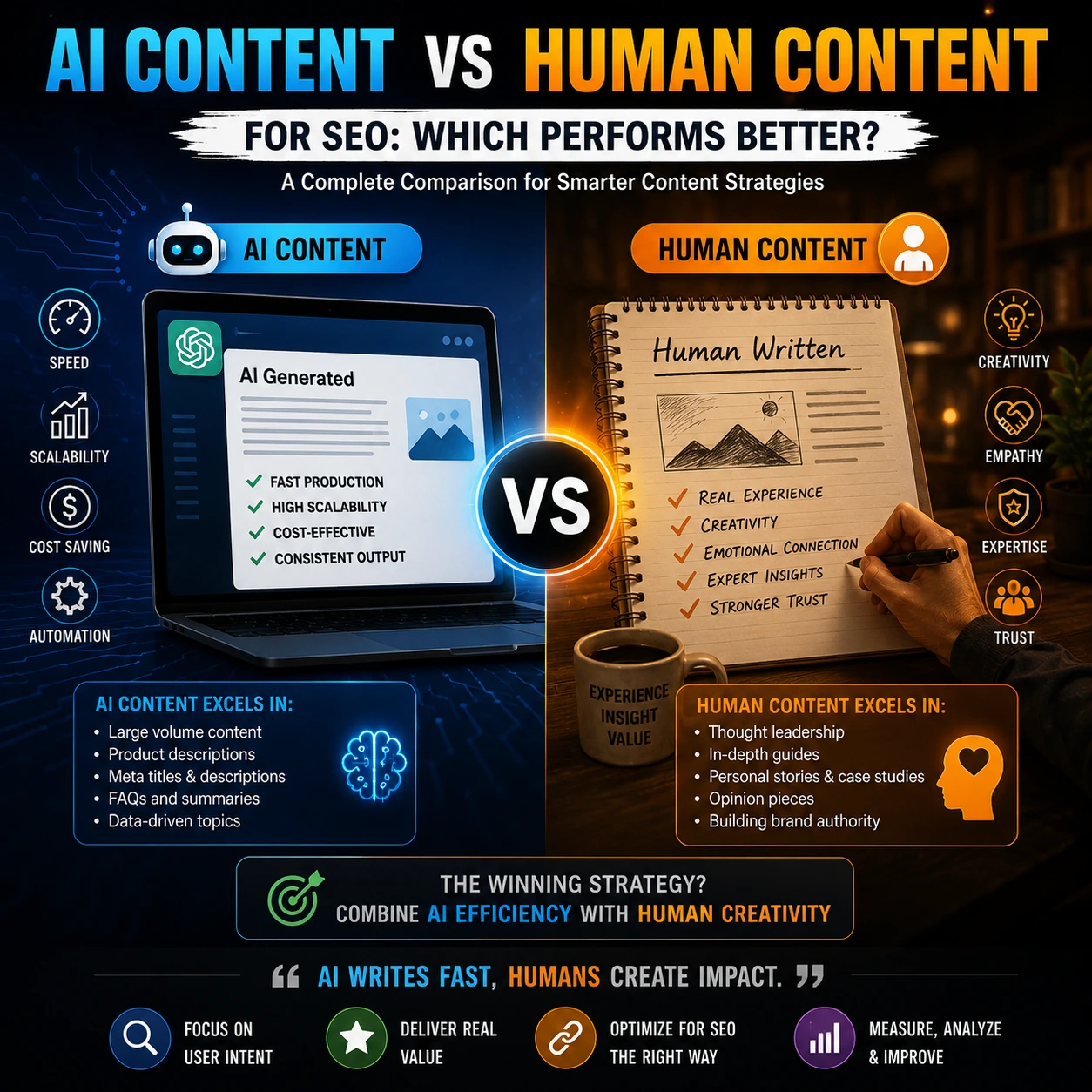
AI-generated content can rank well. Human-written content still holds major advantages. The most successful SEO strategies today are increasingly built around hybrid workflows that combine AI efficiency with human expertise.
This article explores the real differences between AI content and human content for SEO, how search engines evaluate both, where AI excels, where human writers still dominate, and how businesses can build sustainable content strategies for long-term rankings and authority.
Understanding AI Content
AI content refers to text generated using machine learning models trained on vast amounts of online data.
Modern AI writing systems can create:
- Blog articles
- Product descriptions
- Landing pages
- Email campaigns
- SEO metadata
- FAQs
- Ad copy
- Social media content
- Topic outlines
- Content briefs
AI models analyze language patterns and predict the most likely word sequences based on user prompts.
The result is content that often sounds surprisingly natural and readable.
How AI Writing Tools Work
AI systems do not “think” like humans. Instead, they process statistical language relationships from training data.
These tools excel at:
- Pattern recognition
- Content structuring
- Language prediction
- Semantic organization
- Text summarization
However, they lack genuine understanding, real-world experience, emotional reasoning, and personal judgment.
Understanding Human-Written Content
Human-written content is created by writers, journalists, marketers, industry professionals, editors, researchers, or subject-matter experts.
Unlike AI systems, humans contribute:
- Personal experiences
- Original insights
- Emotional nuance
- Creative storytelling
- Critical thinking
- Strategic analysis
- Cultural awareness
- Expert judgment
Human content often reflects genuine expertise and unique perspectives that AI systems struggle to replicate authentically.
Why This Debate Matters for SEO
The AI content debate is not just about writing quality. It directly impacts:
- Search rankings
- Organic traffic
- Content costs
- Publishing speed
- Brand authority
- User trust
- Conversion rates
- Long-term visibility
Businesses investing heavily in content marketing need to understand how search engines evaluate AI-generated and human-written content.
A strong foundation in modern SEO principles becomes critical as AI reshapes search behavior. A detailed Complete SEO Guide for Beginners explains how search engines increasingly prioritize quality and user intent over outdated optimization tactics.
Does Google Penalize AI Content?
One of the biggest myths in SEO is that Google automatically penalizes AI-generated content.
That is incorrect.
Google Google has publicly stated that it focuses on content quality rather than the method used to create content.
What Google cares about includes:
- Helpfulness
- Relevance
- Expertise
- Originality
- Accuracy
- User satisfaction
- Trustworthiness
Low-quality content performs poorly whether written by humans or AI.
High-quality AI-assisted content can rank extremely well when properly optimized and edited.
Google’s Helpful Content System
Google’s helpful content systems are designed to reward content created for users rather than search engines alone.
This means content should:
- Solve real problems
- Demonstrate expertise
- Provide practical value
- Avoid excessive automation
- Offer original insights
Thin, repetitive AI-generated articles often struggle because they lack genuine depth and usefulness.
AI Content vs Human Content: Core Differences
Content Speed
AI dramatically outperforms humans in speed.
| Factor | AI Content | Human Content |
|---|---|---|
| Production Speed | Extremely fast | Slower |
| Scalability | Very high | Limited |
| Publishing Volume | Massive | Moderate |
| Cost Efficiency | Lower cost | Higher cost |
| Research Ability | Surface-level | Deeper analysis |
| Creativity | Moderate | Excellent |
| Emotional Intelligence | Weak | Strong |
| Strategic Thinking | Limited | Advanced |
| Original Experience | None | Real-world insights |
| Trust Building | Moderate | Strong |
Creativity and Storytelling
Human writers naturally outperform AI in storytelling and emotional engagement.
Humans understand:
- Humor
- Empathy
- Audience psychology
- Persuasion
- Narrative flow
- Brand voice
AI often produces content that sounds technically correct but emotionally flat.
Originality
AI systems generate content based on patterns learned from existing information.
Human writers can create:
- Unique viewpoints
- Original research
- First-hand experiences
- Thought leadership
- Personal observations
This originality strengthens SEO authority and trust.
Accuracy
AI tools sometimes generate inaccurate or fabricated information, commonly called hallucinations.
Human experts generally provide:
- Better fact-checking
- Real-world verification
- Contextual judgment
Accuracy is increasingly important in competitive SEO environments.
Advantages of AI Content for SEO
AI offers major advantages for content marketing teams.
Faster Content Production
AI enables businesses to publish at scale.
This helps with:
- Topic coverage
- Keyword targeting
- Content velocity
- SEO expansion
Lower Content Costs
AI dramatically reduces production expenses for large publishing operations.
Better Workflow Efficiency
AI helps with:
- Draft generation
- Outline creation
- Meta descriptions
- Content refreshes
- Internal linking suggestions
- Keyword integration
A strong Keyword Research Guide becomes even more powerful when paired with AI-assisted content planning.
Semantic SEO Optimization
AI tools are effective at incorporating:
- Related keywords
- Semantic phrases
- Contextual entities
- Long-tail search terms
This supports broader topical relevance.
Content Scaling
AI makes large-scale publishing possible for:
- Ecommerce stores
- Affiliate websites
- SaaS companies
- Media publishers
- Agency clients
Advantages of Human Content for SEO
Despite AI growth, human expertise remains incredibly valuable.
Authentic Expertise
Human writers can share genuine experiences.
Examples include:
- Product testing
- Industry case studies
- Business lessons
- Professional insights
Search engines increasingly value first-hand expertise signals.
Emotional Connection
Humans connect better with readers emotionally.
This improves:
- Engagement
- Brand loyalty
- Trust
- Conversion rates
Strategic Content Creation
Experienced human writers understand:
- Audience pain points
- Buyer intent
- Conversion psychology
- Brand positioning
AI still struggles with advanced strategic reasoning.
Thought Leadership
Authority-building content requires:
- Unique opinions
- Industry perspectives
- Forward-thinking analysis
AI typically summarizes existing information rather than creating new ideas.
How Search Engines Evaluate Content Quality
Search engines increasingly prioritize E-E-A-T:
- Experience
- Expertise
- Authoritativeness
- Trustworthiness
Experience
Content demonstrating real-world experience often performs better.
Examples include:
- Hands-on tutorials
- Product reviews
- Case studies
- Industry examples
Expertise
Search engines evaluate subject depth and topical authority.
Authoritativeness
Authority comes from:
- Brand recognition
- High-quality backlinks
- Expert mentions
- Industry citations
A comprehensive Off-Page SEO Guide explains how authority signals influence rankings.
Trustworthiness
Trust signals include:
- Accurate information
- Transparent sourcing
- Editorial standards
- Secure websites
- Positive user experiences
AI content without oversight often struggles to build trust.
Can AI Content Rank on Google?
Yes, absolutely.
Many websites successfully rank AI-assisted content.
However, successful AI content usually includes:
- Human editing
- Fact verification
- Strategic optimization
- User-focused structure
- Original enhancements
Purely automated low-quality content often performs poorly long term.
When AI Content Performs Best
AI excels in certain SEO scenarios.
Large Topic Coverage
AI helps websites build extensive topical authority quickly.
Ecommerce Product Pages
AI efficiently generates thousands of optimized product descriptions.
FAQ Sections
AI can rapidly create search-intent-focused FAQs.
Content Refreshing
AI assists with:
- Updating outdated posts
- Improving readability
- Expanding sections
Metadata Optimization
AI is highly effective for generating:
- Meta titles
- Meta descriptions
- Header variations
An advanced On-Page SEO Guide helps optimize AI-assisted pages for stronger rankings.
When Human Content Performs Best
Human-created content dominates in areas requiring deeper insight.
Expert Analysis
Industry analysis requires critical thinking and contextual understanding.
Case Studies
Real-world experiences improve credibility significantly.
Emotional Copywriting
Sales-focused pages often perform better with human persuasion techniques.
Investigative Content
Research-heavy journalism still relies heavily on human expertise.
Brand Storytelling
Authentic storytelling builds stronger audience loyalty and trust.
The Rise of Hybrid SEO Content Strategies
The highest-performing content strategies increasingly combine AI and human expertise.
How Hybrid Workflows Work
AI handles:
- Drafting
- Outlining
- Formatting
- SEO suggestions
- Topic clustering
Humans handle:
- Editing
- Fact-checking
- Brand voice
- Strategic insights
- Storytelling
- Experience integration
This balance improves both scalability and quality.
Risks of Overusing AI Content
Businesses relying too heavily on AI face serious risks.
Generic Content Saturation
Many AI articles sound similar because they follow predictable language patterns.
Weak Brand Identity
Unedited AI content often lacks distinctive voice and positioning.
Factual Errors
AI hallucinations can damage:
- Credibility
- User trust
- Search visibility
Thin Content Problems
Mass-produced low-value pages often fail to engage users.
Reduced Trust Signals
Readers increasingly recognize overly automated content.
A detailed Common SEO Mistakes Guide explains why low-quality scaling strategies can hurt rankings.
How To Make AI Content Rank Better
Add Human Expertise
Always include:
- Insights
- Examples
- Opinions
- Real experiences
Improve Readability
Use:
- Short paragraphs
- Bullet points
- Clear headings
- Tables
- Practical examples
Focus on User Intent
Content should solve genuine user problems.
Strengthen Technical SEO
Even excellent content struggles without proper technical foundations.
A complete Technical SEO Guide can improve indexing, speed, and user experience signals.
Build Internal Linking Structures
Strong internal linking improves:
- Crawlability
- Engagement
- Topic relationships
- Authority distribution
AI Content and the Future of SEO
AI is fundamentally reshaping search ecosystems.
Conversational Search Is Growing
Users increasingly search using natural language queries.
Examples:
- “What’s the best SEO strategy for a small business?”
- “Can AI-generated content rank on Google?”
This shift increases the importance of semantic optimization.
Search Engines Are Becoming Smarter
Modern algorithms better understand:
- User intent
- Content quality
- Contextual relationships
- Topical expertise
Zero-Click Search Is Expanding
AI-generated summaries increasingly answer questions directly in search results.
This changes how websites compete for visibility.
Businesses exploring this shift should review how AI Is Changing SEO in 2026 is transforming modern optimization strategies.
AI Search Competition Is Rising
The debate around AI and search continues growing as platforms evolve. The broader discussion around whether ChatGPT will replace Google Search highlights how AI-powered information discovery is reshaping user behavior.
Common Mistakes
Publishing Raw AI Output
Unedited AI articles often contain:
- Repetition
- Weak flow
- Generic phrasing
- Inaccuracies
Ignoring Search Intent
Content should prioritize user satisfaction over keyword density.
Overproducing Thin Content
Publishing hundreds of low-value pages rarely creates sustainable rankings.
Neglecting Human Oversight
AI requires editorial supervision.
Weak Internal Linking
Poor site architecture limits authority distribution.
Forgetting Brand Voice
Generic content struggles to differentiate in competitive markets.
Advanced Strategies
Build Topical Authority Clusters
Create comprehensive ecosystems around core subjects.
Combine AI With Expert Interviews
This dramatically improves uniqueness and authority.
Use AI for Research Assistance
AI can identify:
- Topic gaps
- Semantic opportunities
- Search intent patterns
- Competitor weaknesses
Create Original Data Assets
Unique research strengthens authority signals significantly.
Train Editorial Standards
Develop content systems that maintain:
- Accuracy
- Consistency
- Tone
- Brand positioning
Optimize for AI Search Systems
Future SEO increasingly involves:
- Entity optimization
- Conversational relevance
- Semantic clarity
- Structured content
Key Metrics To Track
Organic Traffic
Track:
- Total visits
- Landing pages
- Traffic growth
- User quality
Engagement Metrics
Important signals include:
- Time on page
- Scroll depth
- Bounce rate
- Returning visitors
Keyword Rankings
Monitor:
- Ranking positions
- Featured snippets
- Topical visibility
Conversion Performance
Measure:
- Leads
- Sales
- Signups
- Revenue impact
Content Production Efficiency
Evaluate:
- Publishing speed
- Editing time
- ROI
- Cost savings
Technical SEO Health
Track:
- Core Web Vitals
- Crawl errors
- Mobile usability
- Site speed
A practical SEO Tools Guide for Beginners can help monitor rankings, performance, and optimization opportunities.
Key Takeaways
- Google does not automatically penalize AI-generated content.
- Content quality matters more than how content is created.
- AI excels at speed, scalability, and workflow efficiency.
- Human writers outperform AI in creativity, emotional intelligence, and expertise.
- Hybrid AI-human workflows often produce the best SEO results.
- AI content requires strong editing and fact-checking.
- Search engines increasingly prioritize experience and trust signals.
- Thin automated content is unlikely to perform well long term.
- Topical authority and user satisfaction remain critical ranking factors.
- Businesses should prioritize originality, usefulness, and expertise.
Frequently Asked Questions
Is AI-generated content bad for SEO?
No. High-quality AI-assisted content can rank well if it is helpful, accurate, and properly optimized.
Can Google detect AI content?
Google may identify AI-generated patterns, but it primarily evaluates usefulness and quality rather than content origin.
Does human-written content rank better?
Not automatically. Well-written human content often performs strongly because it includes expertise and originality, but poor human content can still fail.
Should businesses use AI for SEO content?
Yes, when combined with human editing and strategic oversight.
Can AI replace human writers completely?
No. Human creativity, experience, emotional intelligence, and strategic thinking remain highly valuable.
What are the risks of AI-generated content?
Risks include factual inaccuracies, repetitive phrasing, generic structure, and weak trust signals.
What is the best AI content strategy?
A hybrid workflow combining AI efficiency with human expertise typically delivers the strongest SEO performance.
Does AI-generated content convert well?
It can, but human-refined content often converts better because it connects more effectively with audiences.
Is AI content considered plagiarism?
Usually not, but AI-generated text should always be reviewed for originality and uniqueness.
Will AI dominate SEO in the future?
AI will become increasingly important in SEO workflows, but human expertise and authority will remain essential.
Conclusion
The debate around AI content vs human content for SEO is not about choosing one side exclusively. The future of SEO belongs to businesses that understand how to combine both intelligently.
AI offers incredible advantages in speed, scalability, efficiency, and automation. Human writers contribute originality, emotional depth, strategic thinking, and authentic expertise that AI still cannot fully replicate.
Search engines continue evolving toward quality-focused ranking systems that reward usefulness, trustworthiness, topical authority, and real user value. Generic content — whether written by AI or humans — is becoming less effective in competitive search environments.
The most successful SEO strategies today use AI as a productivity enhancer rather than a replacement for human expertise. Businesses that blend AI-powered workflows with expert-driven insights can produce scalable content without sacrificing authority or quality.
As AI reshapes the future of search and content marketing, one principle remains unchanged: valuable content created for real users will always outperform content created purely for algorithms.