
Table of Contents
Search engine optimization has evolved far beyond keyword stuffing and basic metadata. Today, ranking on search engines requires a strategic balance between technical precision, content quality, user experience, search intent alignment, and topical authority.
Many websites fail to rank not because their content lacks value, but because their on-page SEO foundation is weak. Even exceptional content can remain invisible if pages are poorly optimized, difficult to crawl, slow to load, or disconnected from user intent.
A strong on-page SEO checklist solves these problems systematically.
Whether you run a blog, eCommerce store, SaaS website, affiliate platform, local business website, or enterprise publication, mastering on-page SEO gives you a measurable competitive advantage. It helps search engines understand your content while improving engagement, click-through rates, time on page, and conversions.
This comprehensive guide covers every major on-page SEO factor that directly or indirectly influences rankings. From keyword research and title tags to content structure, internal linking, Core Web Vitals, schema markup, and user experience optimization, this checklist is designed to help you build pages that both users and search engines trust.
What Is On-Page SEO?
On-page SEO refers to all optimization practices performed directly on a webpage to improve its visibility in search engines and enhance user experience.
Unlike off-page SEO, which focuses on backlinks and external signals, on-page SEO concentrates on elements you can fully control within your website.
These include:
- Content quality
- Keyword optimization
- Meta tags
- URL structure
- Internal links
- Heading hierarchy
- Image optimization
- Page speed
- Mobile usability
- Schema markup
- User experience signals
The goal is simple: make your pages highly relevant, accessible, and valuable for both search engines and users.
Why On-Page SEO Matters
Search engines analyze hundreds of signals to determine rankings. Many of the most influential signals come directly from on-page factors.
Effective on-page SEO helps:
- Improve organic visibility
- Increase click-through rates
- Reduce bounce rates
- Enhance readability
- Strengthen topical relevance
- Improve crawlability and indexing
- Increase conversion opportunities
- Support long-term ranking stability
Without proper optimization, even authoritative websites struggle to maximize their search potential.
Complete On-Page SEO Checklist
1. Start With Search Intent Optimization
Search intent is the foundation of modern SEO.
Google prioritizes pages that best satisfy user intent. If your content does not align with what users actually want, rankings become difficult regardless of backlinks or domain authority.
The Four Main Types of Search Intent
| Intent Type | Example Query | User Goal |
|---|---|---|
| Informational | “What is on-page SEO” | Learn something |
| Navigational | “YouTube Studio login” | Find a specific page |
| Transactional | “Buy gaming laptop online” | Purchase something |
| Commercial Investigation | “Best SEO tools” | Compare options |
How to Optimize for Search Intent
- Analyze top-ranking pages
- Study content formats already ranking
- Match article depth to competitor standards
- Address user questions directly
- Avoid misleading headlines
- Deliver immediate value
Common Search Intent Mistakes
- Writing sales content for informational keywords
- Creating thin content for competitive topics
- Ignoring user expectations
- Over-optimizing for keywords instead of usefulness
2. Conduct Smart Keyword Research
Keyword research remains essential, but modern SEO requires semantic understanding rather than exact-match repetition.
Focus on Keyword Categories
Primary Keywords
Your main target phrase.
Example:
- On-page SEO checklist
Secondary Keywords
Closely related variations.
Examples:
- On-page SEO techniques
- SEO page optimization
- SEO content optimization
Long-Tail Keywords
Specific low-competition phrases.
Examples:
- On-page SEO checklist for beginners
- How to optimize blog posts for SEO
- Best on-page SEO practices for ranking
Semantic Keywords
Contextual terms related to the topic.
Examples:
- Search intent
- Meta tags
- Core Web Vitals
- Internal linking
- Crawlability
Best Practices for Keyword Placement
Place keywords naturally in:
- Title tag
- H1 heading
- Introduction
- URL
- Meta description
- Subheadings
- Image alt text
- Conclusion
Avoid keyword stuffing at all costs.
3. Optimize the SEO Title Tag
The title tag is one of the strongest on-page ranking signals.
It also directly impacts click-through rates from search results.
Best Practices for Title Tags
- Keep between 50–60 characters
- Include primary keyword near the beginning
- Make it compelling
- Add emotional or value-driven language
- Avoid duplicate titles
Strong Title Examples
- On-Page SEO Checklist for Better Rankings
- 25 On-Page SEO Tips That Actually Work
- Complete On-Page SEO Guide for Higher Google Rankings
Weak Title Examples
- SEO Article
- Website Optimization Tips
- Learn SEO Today
4. Write High-Converting Meta Descriptions
Meta descriptions do not directly influence rankings, but they strongly affect click-through rates.
Ideal Meta Description Formula
- Include primary keyword
- Keep under 155–160 characters
- Focus on benefits
- Create curiosity or urgency
Example
Learn the ultimate on-page SEO checklist to improve rankings, increase traffic, optimize content, and boost user engagement effectively.
5. Use Proper Heading Structure
Heading hierarchy improves readability and helps search engines understand page structure.
Correct Heading Structure
| Heading | Purpose |
|---|---|
| H1 | Main topic |
| H2 | Major sections |
| H3 | Subsections |
| H4 | Supporting details |
Best Practices
- Use only one H1
- Include keywords naturally
- Keep headings descriptive
- Avoid generic headings
- Structure content logically
6. Create High-Quality Content
Content quality is the core of modern SEO.
Google increasingly prioritizes:
- Expertise
- Experience
- Authority
- Trustworthiness
Thin, repetitive, or low-value content struggles to rank consistently.
Characteristics of High-Quality SEO Content
Comprehensive Coverage
Cover the topic deeply.
Original Insights
Add expert analysis and unique perspectives.
Readability
Use:
- Short paragraphs
- Clear language
- Bullet points
- Logical flow
Accuracy
Ensure factual correctness and current relevance.
Engagement
Maintain reader attention through:
- Examples
- Comparisons
- Actionable advice
- Data
- Visual structure
7. Optimize URL Structure
URLs should be clean, readable, and descriptive.
Good URL Example
example.com/on-page-seo-checklist
Bad URL Example
example.com/post?id=7282&cat=seo123
URL Optimization Tips
- Keep URLs short
- Include target keyword
- Use hyphens instead of underscores
- Avoid unnecessary numbers
- Maintain logical hierarchy
8. Improve Content Readability
Search engines monitor user behavior signals.
If visitors leave quickly, rankings may decline over time.
Readability Optimization Checklist
- Use short sentences
- Limit paragraph length
- Add white space
- Use transition words
- Avoid jargon where unnecessary
- Write conversationally
Recommended Reading Level
Most successful online content performs best around Grade 6–9 readability.
9. Optimize Images Properly
Images improve engagement, but unoptimized media slows websites and hurts SEO.
Image SEO Checklist
- Compress images
- Use descriptive file names
- Add alt text
- Use modern formats like WebP
- Implement lazy loading
- Optimize dimensions
Good Alt Text Example
“SEO expert analyzing website optimization metrics”
Bad Alt Text Example
“IMG_88291”
10. Improve Internal Linking
Internal links help search engines discover pages and understand site architecture.
They also distribute authority throughout your website.
Benefits of Internal Linking
- Improves crawlability
- Increases time on site
- Reduces bounce rates
- Supports topic clusters
- Strengthens contextual relevance
Internal Linking Best Practices
- Use descriptive anchor text
- Link to relevant pages
- Avoid excessive linking
- Prioritize important pages
- Update older content with new links
11. Optimize for Featured Snippets
Featured snippets appear above standard search results and can dramatically increase visibility.
Types of Featured Snippets
- Paragraph snippets
- List snippets
- Table snippets
- Video snippets
How to Optimize for Snippets
- Answer questions directly
- Use concise definitions
- Structure content clearly
- Add numbered lists
- Include comparison tables
Example
What Is On-Page SEO?
On-page SEO is the process of optimizing webpage elements such as content, headings, metadata, and internal links to improve search engine rankings and user experience.
12. Use Schema Markup
Schema markup helps search engines understand page context more effectively.
Common Schema Types
| Schema Type | Use Case |
|---|---|
| Article | Blog posts |
| FAQ | Frequently asked questions |
| Product | eCommerce pages |
| Review | Ratings and testimonials |
| Local Business | Local SEO |
| Breadcrumb | Site navigation |
Benefits of Schema Markup
- Rich search results
- Improved click-through rates
- Better indexing clarity
- Enhanced SERP appearance
13. Optimize for Mobile Devices
Google uses mobile-first indexing.
If your website performs poorly on smartphones, rankings can suffer significantly.
Mobile SEO Checklist
- Responsive design
- Fast loading speed
- Readable text sizes
- Proper spacing
- Clickable buttons
- Mobile-friendly navigation
Common Mobile SEO Problems
- Intrusive popups
- Tiny fonts
- Horizontal scrolling
- Slow image loading
- Unresponsive layouts
14. Improve Page Speed
Page speed directly affects user experience and SEO performance.
Key Speed Optimization Techniques
Minimize HTTP Requests
Reduce unnecessary scripts and assets.
Enable Browser Caching
Store static resources locally.
Compress Files
Use GZIP or Brotli compression.
Optimize Images
Large images are among the biggest speed killers.
Use a CDN
Content delivery networks improve global load times.
Important Speed Metrics
| Metric | Ideal Target |
|---|---|
| Largest Contentful Paint (LCP) | Under 2.5 seconds |
| First Input Delay (FID) | Under 100 ms |
| Cumulative Layout Shift (CLS) | Under 0.1 |
15. Focus on Core Web Vitals
Core Web Vitals are user experience metrics used by Google as ranking signals.
The Three Core Web Vitals
Largest Contentful Paint (LCP)
Measures loading performance.
Interaction to Next Paint (INP)
Measures responsiveness.
Cumulative Layout Shift (CLS)
Measures visual stability.
How to Improve Core Web Vitals
- Reduce server response time
- Optimize CSS and JavaScript
- Use lazy loading
- Eliminate layout shifts
- Prioritize above-the-fold content
16. Use External Links Strategically
Linking to authoritative sources improves trust and contextual relevance.
Best Practices
- Link to credible sources
- Avoid spammy websites
- Use relevant references
- Open external links appropriately
- Keep links updated
17. Optimize Anchor Text
Anchor text helps search engines understand linked page context.
Good Anchor Text
- “advanced technical SEO strategies”
- “complete keyword research guide”
Bad Anchor Text
- “click here”
- “read more”
Anchor Text Tips
- Be descriptive
- Stay natural
- Avoid over-optimization
- Vary anchor phrases
18. Improve Content Freshness
Fresh content often performs better in competitive industries.
Ways to Keep Content Fresh
- Update statistics
- Add new insights
- Refresh screenshots
- Expand outdated sections
- Improve formatting
- Add current trends
Content Refresh Frequency
Highly competitive topics may require updates every 3–6 months.
19. Optimize User Experience Signals
Search engines increasingly measure user satisfaction indirectly.
Important UX Signals
- Time on page
- Bounce rate
- Scroll depth
- Engagement
- Navigation ease
UX Improvement Strategies
- Clear layout
- Fast loading
- Helpful content
- Logical structure
- Minimal distractions
20. Add FAQ Sections
FAQ sections improve usability and support long-tail keyword optimization.
They also increase opportunities for featured snippets.
FAQ Best Practices
- Use natural questions
- Provide concise answers
- Address real user concerns
- Include semantic variations
21. Avoid Duplicate Content
Duplicate content confuses search engines and dilutes ranking potential.
Common Causes
- Multiple URL variations
- Copied product descriptions
- Parameter-based pages
- Poor canonicalization
Solutions
- Use canonical tags
- Create unique content
- Consolidate duplicates
- Redirect unnecessary URLs
22. Optimize for Topical Authority
Modern SEO rewards websites that demonstrate deep expertise across related topics.
How to Build Topical Authority
- Create content clusters
- Cover subtopics comprehensively
- Interlink related articles
- Maintain niche consistency
- Publish regularly
Example SEO Topic Cluster
Main Topic:
- On-page SEO
Supporting Topics:
- Keyword research
- Technical SEO
- Internal linking
- Schema markup
- Page speed optimization
23. Use E-E-A-T Principles
Google evaluates content using Experience, Expertise, Authoritativeness, and Trustworthiness.
How to Improve E-E-A-T
Experience
Show real-world insights and practical knowledge.
Expertise
Provide accurate, informed content.
Authoritativeness
Build reputation through quality and consistency.
Trustworthiness
Ensure transparency, security, and credibility.
24. Optimize Calls to Action
SEO traffic is valuable only when it contributes to business goals.
Effective CTA Examples
- Download the guide
- Start your free trial
- Request a consultation
- Read the full case study
CTA Best Practices
- Keep CTAs relevant
- Avoid excessive promotion
- Place strategically
- Focus on user value
25. Monitor SEO Performance
SEO is an ongoing process.
Continuous monitoring helps identify opportunities and prevent ranking losses.
Key Metrics to Track
| Metric | Why It Matters |
|---|---|
| Organic traffic | Measures SEO growth |
| Keyword rankings | Tracks visibility |
| Click-through rate | Measures SERP effectiveness |
| Bounce rate | Indicates engagement |
| Conversion rate | Measures business impact |
| Indexed pages | Confirms crawlability |
Recommended SEO Tools
- Google Search Console
- Google Analytics
- Ahrefs
- Semrush
- Screaming Frog
- PageSpeed Insights
Common On-Page SEO Mistakes
Many websites lose rankings because of avoidable optimization errors.
Most Common Mistakes
Keyword Stuffing
Overusing keywords reduces readability and may trigger spam signals.
Thin Content
Short, low-value pages rarely perform well competitively.
Ignoring Search Intent
Even optimized pages fail if intent mismatch exists.
Poor Mobile Experience
Mobile usability problems hurt engagement and rankings.
Slow Website Speed
Users abandon slow websites quickly.
Missing Internal Links
Weak site architecture limits crawlability and authority flow.
Duplicate Metadata
Repeated titles and descriptions reduce differentiation.
Weak Content Structure
Disorganized pages confuse users and search engines.
Advanced On-Page SEO Strategies
Once foundational optimization is complete, advanced strategies can help outperform competitors.
Semantic SEO
Semantic SEO focuses on topic relationships rather than exact-match keywords.
Best Practices
- Cover entities naturally
- Answer related questions
- Use contextual terminology
- Expand topic depth
Content Gap Analysis
Analyze competitor weaknesses and identify missing subtopics.
Benefits
- Find untapped keywords
- Discover ranking opportunities
- Improve content comprehensiveness
Entity-Based Optimization
Search engines increasingly understand entities and relationships.
Example SEO Entities
For “on-page SEO”:
- Google Search Console
- Meta tags
- Core Web Vitals
- Internal links
- Structured data
Search Experience Optimization
Modern SEO extends beyond rankings into total user experience.
Focus Areas
- Faster load times
- Better navigation
- Cleaner design
- Accessibility improvements
- Intent satisfaction
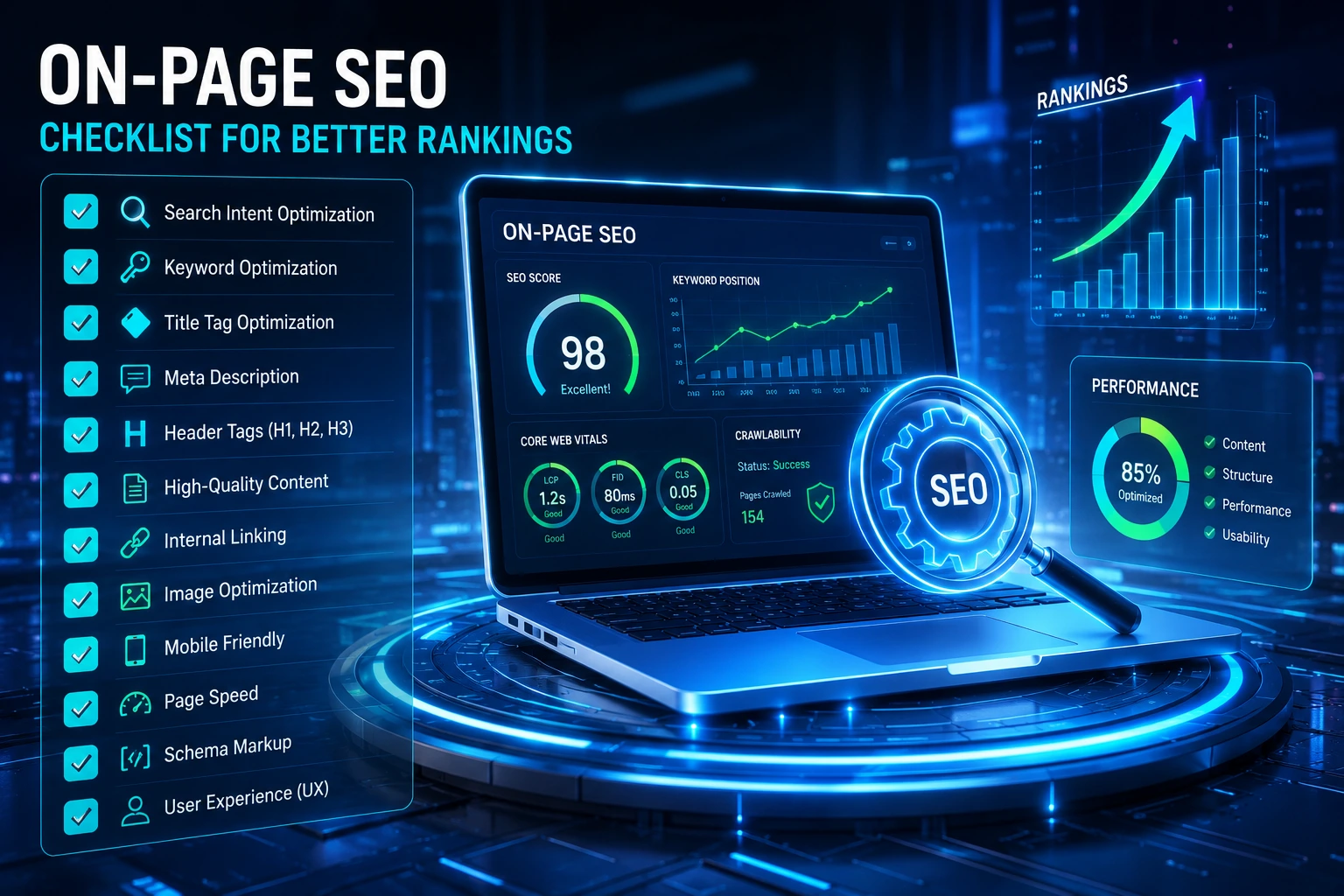
On-Page SEO Checklist Summary
Here is a simplified master checklist for quick implementation.
| SEO Element | Optimized? |
|---|---|
| Search intent alignment | Yes |
| Primary keyword targeting | Yes |
| Semantic keyword integration | Yes |
| Optimized title tag | Yes |
| Strong meta description | Yes |
| Proper heading structure | Yes |
| High-quality content | Yes |
| Internal linking | Yes |
| Mobile optimization | Yes |
| Fast loading speed | Yes |
| Schema markup | Yes |
| Optimized images | Yes |
| Clean URLs | Yes |
| FAQ section | Yes |
| Core Web Vitals optimization | Yes |
| User experience improvements | Yes |
| Content freshness | Yes |
| E-E-A-T signals | Yes |
Frequently Asked Questions
1. What is the most important on-page SEO factor?
Content quality and search intent alignment are generally the most important factors. Without satisfying user intent, other optimizations have limited impact.
2. How many keywords should I use on a page?
There is no exact number. Focus on natural keyword placement and semantic relevance instead of density percentages.
3. Does page speed affect SEO rankings?
Yes. Slow-loading pages negatively affect user experience and can reduce rankings, especially on mobile devices.
4. How long should SEO content be?
Content length depends on search intent and competition. Comprehensive coverage is more important than arbitrary word counts.
5. Are meta descriptions still important?
Yes. While they may not directly influence rankings, they strongly impact click-through rates from search results.
6. What is keyword stuffing?
Keyword stuffing is the excessive repetition of keywords in content unnaturally. It harms readability and can trigger spam signals.
7. Why are internal links important?
Internal links improve crawlability, distribute authority, and help users navigate related content.
8. What are Core Web Vitals?
Core Web Vitals are Google metrics measuring page speed, responsiveness, and visual stability.
9. How often should content be updated?
Important SEO content should be reviewed regularly, especially in fast-changing industries. Updating every few months is often beneficial.
10. Can on-page SEO alone rank a website?
On-page SEO is essential, but competitive rankings usually also require strong backlinks, technical SEO, and overall domain authority.
Key Takeaways
- On-page SEO is the foundation of sustainable organic rankings.
- Search intent optimization is more important than keyword density.
- High-quality content remains the strongest ranking driver.
- Technical performance directly affects user experience and rankings.
- Internal linking strengthens topical authority and crawlability.
- Mobile optimization is no longer optional.
- Core Web Vitals influence both UX and SEO performance.
- Semantic SEO improves contextual relevance.
- E-E-A-T principles help build long-term trust and authority.
- Continuous optimization is necessary for competitive rankings.
Conclusion
On-page SEO is no longer about simply inserting keywords into content. It is a comprehensive process that combines technical precision, content strategy, user psychology, semantic understanding, and experience optimization.
The most successful websites treat on-page SEO as an integrated system rather than a checklist of isolated tactics. Every element — from title tags and internal links to page speed and content depth — contributes to overall search performance.
Search engines are increasingly sophisticated in evaluating content quality and user satisfaction. Websites that prioritize helpfulness, clarity, expertise, and usability consistently outperform those relying on outdated optimization shortcuts.
By implementing the strategies in this on-page SEO checklist, you create pages that are easier to crawl, more engaging to users, and more competitive in search rankings.
SEO success rarely comes from one single tactic. It comes from consistent execution across every important ranking factor. When your content genuinely solves problems while maintaining strong technical