
Table of Contents
Introduction
For more than two decades, Google Search has shaped how people access information online. From quick fact-checking to product research, navigation, education, and entertainment, Google became the default gateway to the internet. But the rise of AI-powered tools like OpenAI ChatGPT has sparked a major question across the tech industry, digital marketing world, and everyday internet users: will ChatGPT replace Google Search?
The conversation is no longer theoretical. Millions of users now ask AI chatbots questions they previously typed into search engines. Instead of scrolling through ten blue links, users increasingly prefer direct answers, summarized insights, personalized recommendations, and conversational interactions. This shift is changing user behavior at a pace few expected.
At the same time, Google is rapidly integrating AI into its own ecosystem through AI-generated search summaries, conversational search experiences, and machine learning-powered ranking systems. The competition is not simply “ChatGPT vs Google.” It is a much bigger transformation in how humans interact with information online.
For businesses, publishers, marketers, and SEO professionals, this shift has enormous implications. Website traffic patterns are evolving. Search intent is changing. Content optimization strategies are adapting. Traditional SEO rules are being rewritten in real time.
This article explores whether ChatGPT can realistically replace Google Search, what the future of search may look like, how AI search impacts SEO, where Google still dominates, and what businesses must do to stay visible in the AI-driven web ecosystem.
Understanding the Difference Between ChatGPT and Google Search
Before predicting the future, it is essential to understand how these platforms fundamentally differ.
What Is ChatGPT?
OpenAI ChatGPT is an AI language model designed to generate human-like responses based on prompts and conversational input. Instead of displaying a list of websites, it synthesizes information into direct answers.
Core capabilities include:
- Conversational interaction
- Context retention
- Summarized explanations
- Writing assistance
- Research support
- Coding help
- Brainstorming
- Personalized responses
Users interact with ChatGPT more like a virtual assistant than a traditional search engine.
What Is Google Search?
Google Google Search indexes billions of web pages and ranks them based on relevance, authority, user experience, backlinks, freshness, and hundreds of other ranking factors.
Google primarily provides:
- Website links
- Featured snippets
- Knowledge panels
- Maps
- Shopping results
- Videos
- News results
- Local business listings
Rather than generating original answers from scratch, Google directs users toward external sources.
Core Difference
The biggest difference is simple:
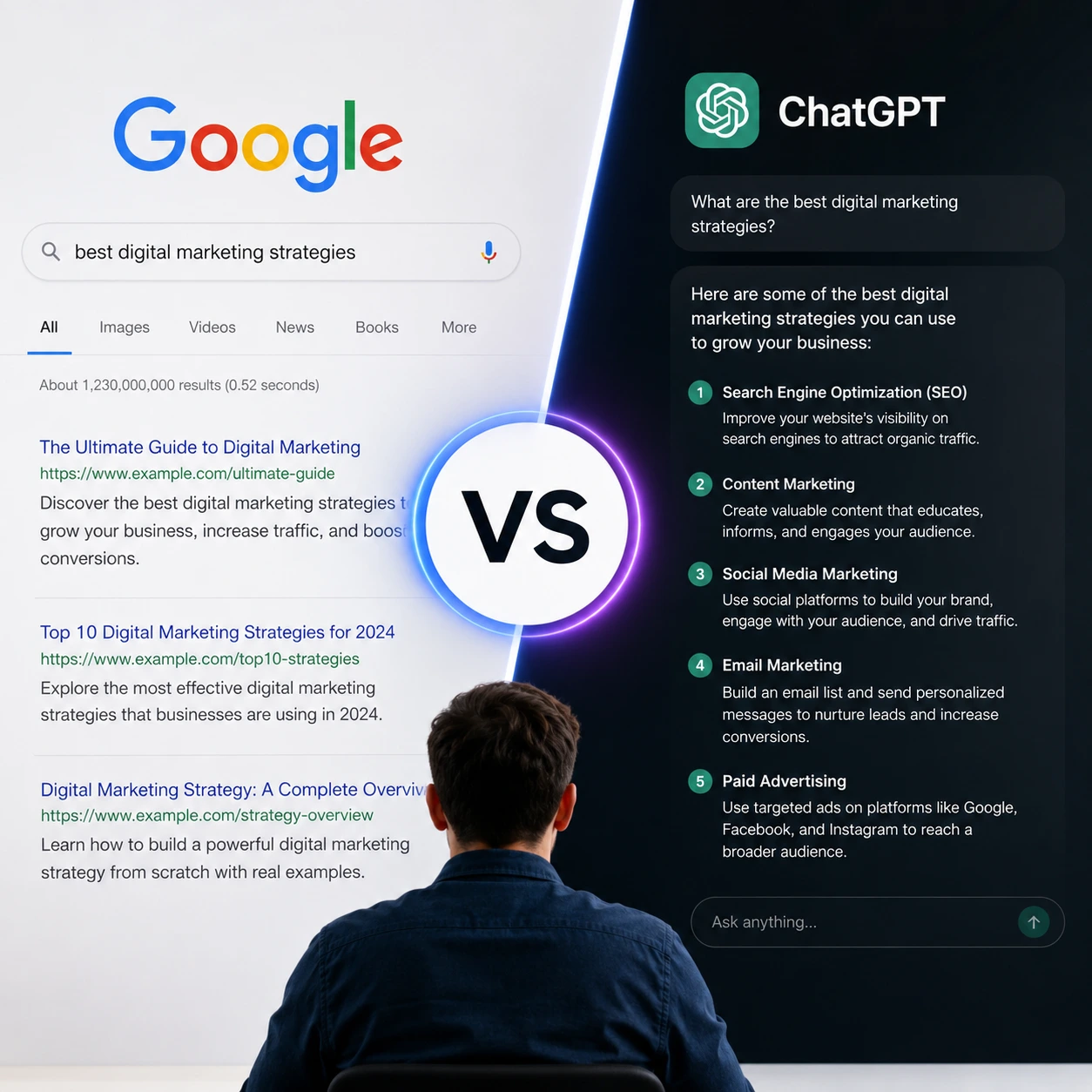
- ChatGPT delivers answers.
- Google delivers destinations.
That distinction alone explains why AI search is disrupting traditional search behavior.
Why People Are Starting to Use ChatGPT Instead of Google
The rapid adoption of AI chatbots did not happen accidentally. Users are solving real frustrations they experienced with traditional search engines.
Faster Answers
Many users no longer want to scan multiple articles for a simple answer.
Instead of searching:
“Best beginner SEO strategies for small businesses”
Users can ask:
“What are the best SEO strategies for a small business with limited budget?”
ChatGPT instantly organizes the answer into readable steps.
For users seeking SEO guidance, a detailed Complete SEO Guide can still provide deeper implementation details beyond summarized AI responses.
Reduced Information Overload
Google often presents:
- Ads
- Affiliate pages
- SEO-optimized listicles
- Sponsored results
- Forum discussions
- Duplicate content
Users sometimes spend more time filtering results than consuming useful information.
AI tools simplify the process by condensing relevant insights into one conversation.
Personalized Conversations
ChatGPT adapts to user context and follow-up questions.
For example:
- “Explain this like I’m a beginner.”
- “Give me advanced examples.”
- “Compare strategies for ecommerce sites.”
This conversational layer creates a more interactive experience than static search results.
Content Summarization
Instead of reading 10 separate pages, users can request:
- Quick summaries
- Bullet points
- Action plans
- Step-by-step instructions
This dramatically improves efficiency for many informational queries.
Better for Complex Queries
Traditional search works well for simple keywords.
AI often performs better for:
- Multi-step reasoning
- Strategic advice
- Comparative analysis
- Creative tasks
- Educational explanations
Why Google Search Still Dominates
Despite AI hype, Google remains incredibly powerful for several reasons.
Real-Time Information
Google excels at:
- Breaking news
- Live sports scores
- Financial updates
- Weather
- Local business information
- Product availability
- Current events
AI models may not always have real-time awareness unless connected to live web systems.
Source Verification
Google allows users to inspect original sources directly.
This matters for:
- Medical information
- Legal advice
- Scientific research
- Academic studies
- News verification
Users often want transparency, not just generated answers.
Website Ecosystem
The internet economy depends heavily on search traffic.
Millions of businesses rely on Google for:
- Organic traffic
- Leads
- Ecommerce sales
- Advertising revenue
- Brand visibility
Completely replacing this ecosystem would fundamentally disrupt the web itself.
Local Search Dominance
Google remains dominant for local intent searches such as:
- Restaurants near me
- Dentists nearby
- Hotels
- Service providers
- Directions
- Reviews
Local SEO remains critical for businesses targeting geographic audiences. A strong Local SEO Guide becomes even more important as AI-enhanced local search evolves.
Shopping and Commercial Intent
Google still performs exceptionally well for:
- Product comparisons
- Online shopping
- Reviews
- Price tracking
- Purchase research
Users often want multiple vendor options, images, videos, and reviews before buying.
How AI Is Transforming Search Behavior
The real story is not whether ChatGPT completely replaces Google. The bigger story is how AI changes user expectations.
Users Expect Instant Synthesis
People increasingly expect:
- Direct answers
- Condensed insights
- Personalized recommendations
- Fewer clicks
This changes how websites must structure content.
Search Queries Are Becoming Conversational
Old-style searches:
- “best protein powder”
- “seo checklist”
- “technical seo”
New AI-driven searches:
- “What’s the best protein powder for muscle gain without artificial sweeteners?”
- “How do I optimize SEO for a new website with low authority?”
- “What technical SEO mistakes slow down ecommerce rankings?”
This shift increases the importance of semantic SEO and natural language optimization.
A well-structured Keyword Research Guide helps businesses target evolving conversational search intent effectively.
Zero-Click Search Is Expanding
Google already reduced website clicks through:
- Featured snippets
- Knowledge panels
- AI summaries
AI assistants accelerate this trend by answering questions without requiring users to visit websites.
This creates major concerns for publishers and content creators.
Will AI Kill SEO?
One of the most common fears surrounding AI search is whether SEO will disappear.
The short answer is no.
SEO is evolving, not dying.
Why SEO Still Matters
AI systems still need:
- Reliable sources
- Authoritative content
- Structured information
- Trusted websites
- Fresh content
Search engines and AI tools rely heavily on high-quality web content to generate accurate responses.
Without publishers, AI systems would have limited knowledge depth.
SEO Is Shifting Toward Authority
Older SEO tactics focused heavily on:
- Exact-match keywords
- Link manipulation
- Thin content
- Quantity over quality
Modern SEO prioritizes:
- Topical authority
- Expertise
- User satisfaction
- Content depth
- Semantic relevance
- Technical performance
Businesses that publish truly useful content remain highly competitive.
An advanced On-Page SEO Guide helps improve content structure for both traditional search engines and AI-powered systems.
How Google Is Responding to ChatGPT
Google is not ignoring AI disruption.
The company is aggressively integrating AI into search.
AI Overviews
Google now generates AI-powered summaries directly in search results for many queries.
These summaries aim to:
- Reduce search friction
- Improve answer quality
- Compete with AI chatbots
- Keep users inside Google’s ecosystem
Search Generative Experience
Google’s evolving search model combines:
- Traditional links
- Conversational AI
- Follow-up prompts
- Dynamic recommendations
This creates a hybrid search experience rather than replacing search entirely.
AI-Powered Ranking Systems
Google increasingly uses machine learning to evaluate:
- Content quality
- User intent
- Relevance
- Helpful information
- Experience signals
Websites focused purely on SEO manipulation struggle more than ever.
A solid Technical SEO Guide is crucial because AI-enhanced search systems still rely on crawlability, speed, indexing, and user experience signals.
Areas Where ChatGPT Could Replace Google
Certain search categories are especially vulnerable to AI replacement.
Educational Queries
Examples:
- “Explain blockchain technology.”
- “How does SEO work?”
- “What is cloud computing?”
AI often provides faster and more digestible explanations.
Productivity Tasks
Users increasingly rely on AI for:
- Writing
- Summarization
- Email drafting
- Brainstorming
- Coding
- Planning
These tasks were never ideal fits for traditional search engines.
Basic Research
AI can quickly summarize:
- Industry overviews
- Definitions
- Comparisons
- Beginner tutorials
This reduces the need for users to visit multiple informational websites.
Idea Generation
ChatGPT performs well for:
- Business ideas
- Marketing strategies
- Content ideas
- Product naming
- Campaign planning
Traditional search engines are less conversational in these scenarios.
Areas Where Google Will Likely Remain Dominant
AI still has limitations.
Real-Time Search
Google remains stronger for:
- Live updates
- News
- Traffic
- Events
- Flight information
- Stock prices
Transactional Searches
Google dominates high-commercial-intent behavior.
Examples:
- “Buy iPhone online”
- “Best hotels in Dubai”
- “Cheap flights to London”
Users need live inventory, reviews, pricing, and booking systems.
Local Intent
Local SEO remains deeply connected to maps, business listings, and review ecosystems.
AI may assist recommendations, but Google’s infrastructure remains extremely powerful.
Source Discovery
Researchers, journalists, and professionals often want original sources rather than summarized answers.
Google excels at content discovery.
The Future of Search: Hybrid AI Search Engines
The future will likely combine both models.
Search Will Become More Conversational
Users increasingly expect:
- Follow-up questions
- Context retention
- Personalized responses
- Interactive assistance
Websites Will Still Matter
AI cannot replace:
- Original reporting
- Human expertise
- Product databases
- Research studies
- Brand trust
- Unique experiences
Publishers remain essential to the web ecosystem.
AI Search Optimization Will Emerge
SEO is evolving into something broader.
Future optimization strategies may include:
- AI visibility optimization
- Entity optimization
- Semantic content structuring
- Conversational query targeting
- Trust signal enhancement
How Businesses Should Adapt
Businesses that adapt early gain major competitive advantages.
Build Topical Authority
Create comprehensive content ecosystems instead of isolated blog posts.
Cover topics deeply with:
- Tutorials
- Case studies
- FAQs
- Comparisons
- Expert insights
Improve Content Quality
Thin, generic articles struggle increasingly.
Content must demonstrate:
- Expertise
- Experience
- Accuracy
- Originality
- Depth
Optimize for Conversational Search
Use natural language throughout content.
Answer questions users actually ask.
Include:
- Long-tail phrases
- Problem-solving content
- Question-based headings
Focus on Technical SEO
AI systems still rely on technically accessible websites.
Key priorities include:
- Site speed
- Mobile optimization
- Structured data
- Crawlability
- Internal linking
A complete Technical SEO Guide can significantly improve website discoverability in both traditional and AI-enhanced search systems.
Strengthen Brand Authority
Brands with trust and recognition perform better in evolving search ecosystems.
Invest in:
- Thought leadership
- Original research
- Expert-driven content
- Community engagement
Diversify Traffic Sources
Businesses should not depend solely on Google traffic.
Expand into:
- Email marketing
- Social media
- YouTube
- Communities
- Podcasts
- Brand search demand
Impact on Content Creators and Publishers
AI search creates both opportunities and risks.
Potential Challenges
Publishers may face:
- Reduced clicks
- Lower ad revenue
- Increased competition
- Content commoditization
Emerging Opportunities
Strong publishers can still thrive by offering:
- Unique expertise
- Original data
- Human perspectives
- Specialized insights
- Trustworthy reporting
Generic content becomes easier for AI to replace.
High-value expertise becomes more valuable.
Common Mistakes
Businesses often make serious errors when adapting to AI-driven search changes.
Publishing Thin AI Content
Mass-producing low-quality AI articles often leads to:
- Weak engagement
- Poor rankings
- Reduced trust
- Low authority
Ignoring Technical SEO
Many websites focus only on content while neglecting:
- Core Web Vitals
- Site architecture
- Indexability
- Structured data
Over-Optimizing Keywords
Modern search systems understand context.
Keyword stuffing damages readability and user experience.
Neglecting User Intent
Some businesses chase search volume instead of solving user problems.
Intent-driven content performs better long term.
Failing to Build Brand Recognition
Anonymous websites struggle more in competitive search ecosystems.
Strong brands build trust faster.
A detailed guide on Common SEO Mistakes can help businesses avoid ranking losses during the AI transition.
Advanced Strategies
Businesses seeking long-term search visibility should implement advanced strategies early.
Build Entity-Based SEO
Search engines increasingly understand entities instead of simple keywords.
Focus on:
- Brand recognition
- Author authority
- Topic relationships
- Semantic relevance
Use Structured Data Aggressively
Schema markup improves machine readability.
Important schema types include:
| Schema Type | Purpose |
|---|---|
| Article Schema | Improves content understanding |
| FAQ Schema | Supports featured snippets |
| Organization Schema | Strengthens brand identity |
| Product Schema | Enhances ecommerce visibility |
| Review Schema | Builds trust signals |
Create Comprehensive Topic Clusters
Instead of isolated posts:
- Build pillar pages
- Support with subtopics
- Interlink naturally
- Cover full user journeys
Invest in Original Research
AI systems value unique information sources.
Examples:
- Surveys
- Case studies
- Data analysis
- Industry benchmarks
Optimize for AI Citations
Future AI systems may increasingly cite authoritative sources.
To improve visibility:
- Use clear formatting
- Answer questions directly
- Provide factual clarity
- Maintain accuracy
Businesses exploring AI-driven publishing trends should also review how AI Is Changing SEO in 2026 is reshaping search visibility strategies.
Key Metrics To Track
Businesses should monitor both traditional SEO and AI-era visibility signals.
Organic Traffic
Track:
- Total traffic
- Landing pages
- Search growth
- Traffic quality
Engagement Metrics
Important indicators include:
- Time on page
- Bounce rate
- Scroll depth
- Returning visitors
Brand Search Volume
Growing branded searches indicate increasing authority and trust.
Conversion Metrics
Measure:
- Leads
- Sales
- Signups
- Revenue attribution
SERP Visibility
Track:
- Featured snippets
- AI overviews
- Ranking positions
- Click-through rates
Technical SEO Health
Monitor:
- Core Web Vitals
- Crawl errors
- Index coverage
- Mobile usability
Useful SEO Tools for Beginners can simplify tracking and optimization for evolving AI-driven search landscapes.
Key Takeaways
- ChatGPT is transforming how users access information online.
- Google Search still dominates real-time, local, and transactional searches.
- AI is changing search behavior more than replacing search entirely.
- SEO remains highly relevant but is evolving rapidly.
- High-quality, authoritative content matters more than ever.
- Conversational search optimization is becoming essential.
- Businesses should focus on expertise, trust, and user intent.
- Technical SEO remains critical in AI-enhanced search ecosystems.
- Generic content becomes easier for AI systems to replace.
- Strong brands and original insights will gain long-term advantages.
Frequently Asked Questions
Will ChatGPT completely replace Google Search?
Probably not. ChatGPT and Google serve different purposes. AI may replace some informational searches, but Google remains dominant for real-time, transactional, and local queries.
Is SEO still worth investing in?
Yes. SEO continues evolving alongside AI. High-quality, authoritative content remains essential for visibility in both traditional and AI-powered search systems.
Why are users shifting toward AI search tools?
Users prefer faster answers, conversational interactions, summarized insights, and reduced information overload.
Does Google use AI in search?
Yes. Google increasingly integrates AI into search through AI-generated summaries, ranking systems, and conversational search experiences.
What types of searches work best with ChatGPT?
Educational queries, brainstorming, summarization, writing assistance, and strategic explanations often work well with AI systems.
Can AI-generated content rank on Google?
Yes, but quality matters. Helpful, accurate, and original content can rank regardless of how it is produced.
How should businesses adapt to AI search trends?
Businesses should improve content quality, strengthen technical SEO, optimize for conversational intent, and build topical authority.
Will website traffic decrease because of AI answers?
Some informational traffic may decline due to zero-click AI responses, but strong brands and authoritative websites can still thrive.
What is conversational SEO?
Conversational SEO focuses on optimizing content around natural language queries and user intent rather than isolated keywords.
Is Google losing market share because of ChatGPT?
AI tools are influencing user behavior, but Google still maintains enormous global search dominance and continues evolving rapidly.
Conclusion
The question is not whether ChatGPT will completely replace Google Search. The real question is how AI will redefine the future of online information discovery.
Search is evolving from a keyword-based retrieval system into a conversational intelligence experience. Users increasingly expect direct answers, contextual understanding, and personalized interactions. AI platforms are accelerating this transformation faster than many businesses anticipated.
However, Google remains deeply embedded in the internet ecosystem. Its infrastructure, data scale, advertising dominance, local search capabilities, and real-time indexing power are extraordinarily difficult to replace entirely.
The most likely outcome is a hybrid future where AI assistants and traditional search engines coexist, merge, and evolve together. Businesses, publishers, and marketers who adapt early will gain the strongest competitive advantage.
The winners in this new era will not be websites that produce the most content. They will be the brands that create the most trustworthy, useful, technically optimized, and genuinely authoritative content for real users.